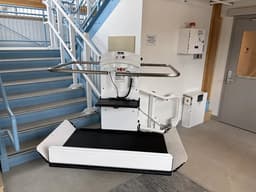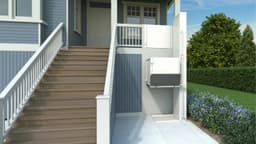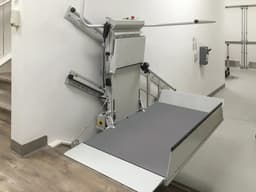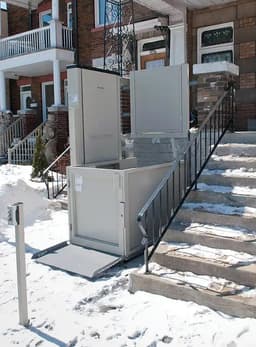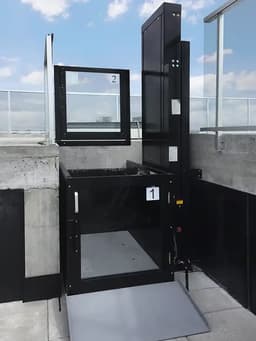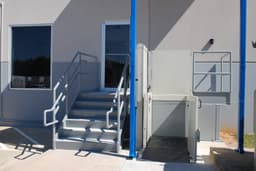
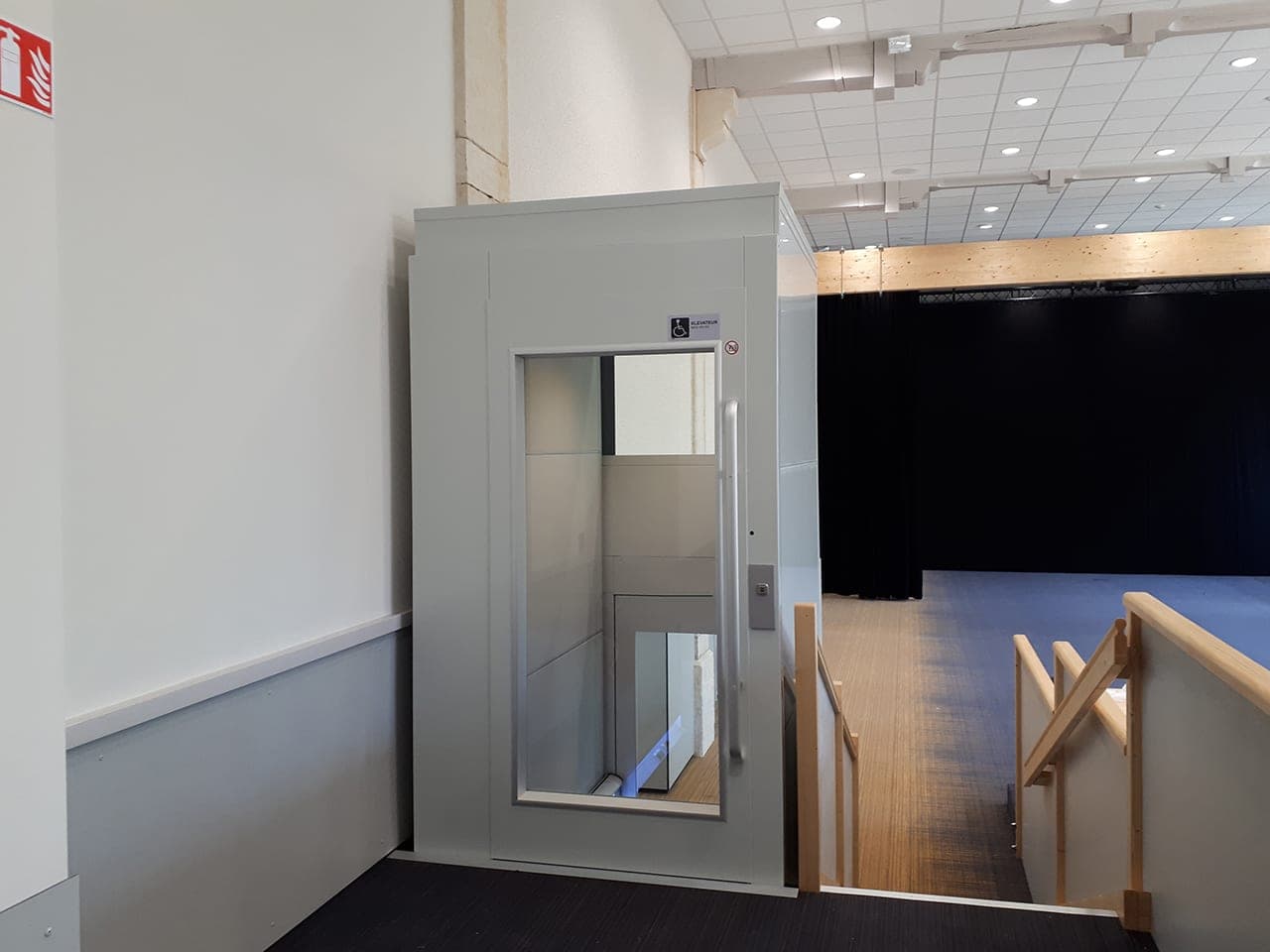
Cibes Primo & Cibes Air® at a glance
Screw-driven vertical platform lifts supplied with their own shaft: the Cibes Primo and Cibes Air.
- Platform sizes
- 17
- Rated load, Primo
- 880 lb
- Max travel
- 23 ft
- Speed
- 30 fpm
- Power, single-phase
- 230 VAC, 16 amp
Key specifications. See the details below for model and installation requirements.
Before you plan
Choose the model and setting
Compare the Primo, Air and outdoor concept before selecting the lift. Compare the versions.
Coordinate the shaft and openings
Confirm the selected size, structural support and building preparation with the project drawings. See site requirements.
Confirm the power arrangement
Review the electrical supply, wiring and controls for the selected configuration. See electrical requirements.
What are the Cibes Primo and Cibes Air, and where do they fit?
The Cibes Primo is a screw-driven, shaft-included vertical platform lift; the Cibes Air is its indoor-only sibling, both for homes and select commercial buildings.
The Cibes Primo is a vertical platform lift driven by a screw and nut. Cibes delivers it with a ready-made shaft in steel panels (glass optional) "so that you do not need to build one." The machinery fits inside the shaft, so there is no machine room. Controls are hold-to-run: the rider holds the floor button to travel and releases it to stop. Speed is 30 fpm.
The Cibes Air® shares the Primo's 17 sizes and core specification but is indoor only, with a designed platform interior and handrail controls. Cibes lists it under "Home Elevators" on its US site, but the technical brochure gives it the same hold-to-run controls and 30 fpm speed as the Primo.
The Primo outdoor concept is a Primo configuration for platform sizes 15 and 16 only. Cibes also calls it the "Cibes Primo Outdoor" and the "Cibes Outdoor Lift".
The Primo is made in Sweden, at the Cibes factory in Gävle, and sold in the US by Cibes Symmetry of Peoria, Illinois, part of Cibes Lift Group. It replaces the Cibes A5000; Cibes calls it the same product with an updated design and 17 sizes instead of 6. Plan new projects from Primo documents, not A5000 drawings.
Cibes Symmetry's New Jersey dealer page lists Mobility123 as a Cibes Symmetry representative for vertical platform lifts in northern New Jersey.
Where it fits
- Homes, for indoor access with up to 4 stops.
- Public and commercial buildings. Cibes marks sizes 11, 12, 13, 15 and 16 as compliant for commercial applications; the plan reviewer decides for each project.
- Sites without a pit. The lift can stand on the floor with an access ramp at the bottom landing; on a public accessible route, check the ramp first (section 04).
- Existing or site-built shafts (Primo), built by others.
- Outdoor access with a Primo in size 15 or 16.
Where it does not fit
- Outdoors with an Air, or with any other Primo size.
- More than 4 stops or more than 23 ft of travel.
- Openings that must be 1 1/2 hour fire-rated (sections 03 and 04).
- An accessible route in new construction where the code does not permit a platform lift (section 07).
- A layout that needs a 42 in side door with standard Cibes doors (section 03).
How do the Primo, the outdoor concept and the Air compare?
The Primo, the Primo outdoor concept and the Cibes Air share core specifications but differ in installation location, door types and shaft materials.
| Item | Cibes Primo | Primo outdoor concept | Cibes Air® |
|---|---|---|---|
| Installation | Indoor | Outdoor | Indoor only |
| Platform sizes | 17 (sizes 1 to 17) | 2 (sizes 15 and 16) | 17 (sizes 1 to 17) |
| Rated load (lb) | 880 | 880 | 660 or 880 |
| Top height, door / gate (in) | 88 5/8 / 43 3/8 | Not published separately; headroom depends on configuration | 88 5/8 / 51 1/4 |
| Platform controls | Large platform controls | Floor buttons, hold-to-run, as on the Primo | Handrail with integrated floor buttons; 7 in display |
| Standard doors | Panoramic steel doors, concealed door closers | Rust proof AL5 aluminum doors | Panoramic doors, concealed door closers |
| Standard shaft | Steel panels; glass optional | Sealed glazed shaft panels | Steel panels; glass optional |
| Design options | RAL colors, glass panels, ceiling lighting | Roof, canopy and climate options (section 06) | Metal, textile or wood back panel; DecoLegno® or metal front panel; LED lit floor safety edges |
Both models share the specification in section 03 and the same standard safety equipment: safety edges on the top of the platform and the floor, overload protection, emergency stop and alarm button, telephone, battery emergency lowering, manual lowering and battery backup.
EcoSilent is Cibes' low-friction drive. The technical brochure (T09) prints "Screw and nut (EcoSilent)" in the drive row for both models. The options brochure (2025.06) and the Primo page call EcoSilent an option. The Air page lists it under standard equipment but calls it optional elsewhere on the same page. Confirm in the quotation whether EcoSilent is included, especially if the project depends on the noise or energy figures in section 05.
What sizes, travel and door openings are available?
The Primo and Air come in 17 platform sizes, travel up to 23 ft over 4 stops, with door openings from 25 5/8 to 41 3/8 in.
| Item (both models) | Value |
|---|---|
| Speed | 30 fpm |
| Maximum travel | 23 ft. "Travel over 14 ft may require a variance from your local jurisdiction." |
| Maximum stops | 4 |
| Pit depth | 0/2 in or 2 3/4 in (product pages: 0, 2 or 2 3/4 in) |
| Minimum headroom | 90 5/8 in (door) |
| Drive, controls, machine room | Screw and nut; hold-to-run; machine room less (MRL); 3 hp motor |
| Door configuration | Single hinged doors (L/R); single entry, open-through or adjacent access |
Cibes' 2025 public-buildings brochure gives a 14 ft maximum travel. The newer technical brochure (501.09/26, September 2026) gives 23 ft. Use 23 ft as the product limit, and settle any travel over 14 ft with Cibes and the AHJ before the design is fixed (section 07).
T09 lists minimum headroom only for the door configuration (Cibes' Primo page reads "full-height door"). It does not define where headroom and top height are measured, and it gives no headroom for a gate configuration. Take both from the project-specific drawings. Cibes' 2025 public-buildings brochure quotes an 89 in overhead; plan to T09's 90 5/8 in minimum headroom (door) and the project drawings.
Platform, shaft and cut-out by size (in, width x depth)
The cut-out is Cibes' term for the minimum size of the pit and of each floor opening. Sizes apply to both the Primo and the Air.
| Size | Platform | Shaft | Cut-out | Note |
|---|---|---|---|---|
| 1 | 22 11/16 x 30 15/16 | 37 13/16 x 34 3/4 | 39 3/8 x 39 1/8 | |
| 2 | 30 9/16 x 30 15/16 | 45 11/16 x 34 3/4 | 47 1/4 x 39 1/8 | |
| 3 | 34 1/2 x 30 15/16 | 49 5/8 x 34 3/4 | 51 3/16 x 39 1/8 | |
| 4 | 38 7/16 x 30 15/16 | 53 9/16 x 34 3/4 | 55 1/8 x 39 1/8 | |
| 5 | 30 9/16 x 34 7/8 | 45 11/16 x 38 11/16 | 47 1/4 x 43 1/16 | |
| 6 | 34 1/2 x 34 7/8 | 49 5/8 x 38 11/16 | 51 3/16 x 43 1/16 | |
| 7 | 38 7/16 x 34 7/8 | 53 9/16 x 38 11/16 | 55 1/8 x 43 1/16 | |
| 8 | 42 3/8 x 34 7/8 | 57 1/2 x 38 11/16 | 59 1/16 x 43 1/16 | |
| 9 | 30 9/16 x 46 3/16 | 45 11/16 x 49 13/16 | 47 1/4 x 54 3/8 | |
| 10 | 34 1/2 x 46 3/16 | 49 5/8 x 49 13/16 | 51 3/16 x 54 3/8 | |
| 11 | 38 7/16 x 48 1/8 | 53 9/16 x 51 3/4 | 55 1/8 x 56 5/16 | Commercial |
| 12 | 38 7/16 x 52 1/16 | 53 9/16 x 55 11/16 | 55 1/8 x 60 1/4 | Commercial |
| 13 | 42 3/8 x 52 1/16 | 57 1/2 x 55 11/16 | 59 1/16 x 60 1/4 | Commercial |
| 14 | 34 1/2 x 56 | 49 5/8 x 59 5/8 | 51 3/16 x 64 3/16 | |
| 15 | 38 7/16 x 56 | 53 9/16 x 59 5/8 | 55 1/8 x 64 3/16 | Commercial; Primo outdoor |
| 16 | 42 3/8 x 56 | 57 1/2 x 59 5/8 | 59 1/16 x 64 3/16 | Commercial; Primo outdoor |
| 17 | 42 3/8 x 61 1/8 | 57 1/2 x 64 3/4 | 59 1/16 x 69 5/16 | Custom door for 90-degree, side B |
"Commercial" is Cibes' note: "Platform size is compliant for commercial applications." The size 17 note reads: "For code-compliant applications requiring a 90-degree lift configuration with the lowest landing on the B side, a custom door is required." Cibes adds: "Shaft and cut out sizes may vary depending on lift configuration. For exact measurements, please ask Cibes for project specific drawings."
Door opening width by size (in)
In the T09 plan drawings, side D is the machinery (mast) side, side B is opposite it, and sides A and C are the two sides between. Side A or C widths are the same for every door type.
| Size | Side A or C, all door types | Side B, steel (A10, A20) | Side B, aluminum (AL5, AL6) | Side B, gate (A15, A25) |
|---|---|---|---|---|
| 1 | none listed | 27 5/8 | 25 5/8 | none listed |
| 2 | 27 5/8 | 27 5/8 | 25 5/8 | none listed |
| 3 | 31 1/2 | 27 5/8 | 25 5/8 | none listed |
| 4 | 35 1/2 | 27 5/8 | 25 5/8 | none listed |
| 5 | 27 5/8 | 31 1/2 | 29 5/8 | none listed |
| 6 | 31 1/2 | 31 1/2 | 29 5/8 | none listed |
| 7 | 35 1/2 | 31 1/2 | 29 5/8 | none listed |
| 8 | 35 1/2 | 31 1/2 | 29 5/8 | none listed |
| 9 | 27 5/8 | 29 5/8 | 31 1/2 | 29 5/8 |
| 10 | 31 1/2 | 29 5/8 | 31 1/2 | 29 5/8 |
| 11 | 35 1/2 | 31 1/2 | 33 1/2 | 31 1/2 |
| 12 | 35 1/2 | 35 1/2 | 37 1/2 | 35 1/2 |
| 13 | 35 1/2 | 35 1/2 | 37 1/2 | 35 1/2 |
| 14 | 31 1/2 | 39 3/8 | 41 3/8 | 39 3/8 |
| 15 | 35 1/2 | 39 3/8 | 41 3/8 | 39 3/8 |
| 16 | 35 1/2 | 39 3/8 | 41 3/8 | 39 3/8 |
| 17 | 35 1/2 | 39 3/8 | 41 3/8 | Custom door (see size 17 note) |
Across all sizes and door types, T09 door opening widths run from 25 5/8 in to 41 3/8 in. T09 calls these "door opening width" and does not say whether they equal the clear width measured under the ADA. Confirm clear widths with Cibes before you fix the layout (section 07).
Doors and gates (T09 p4)
| Model | Type | Material, standard finish | Height (in) | Glass, w x h (in) |
|---|---|---|---|---|
| A20 | Single hinged door | Steel, RAL 9016 | 78 3/4 | 28 1/8 x 62 |
| A10 / A0 | Single hinged door | Steel, RAL 9016 | 78 3/4 | 3 5/8 x 39 3/4 |
| AL5 | Single hinged door | Aluminum, natural | 81 1/2 | 30 1/2 x 72 1/4 |
| AL6 | Single hinged door | Aluminum, natural | 81 1/2 | 32 1/2 x 78 3/4 |
| A25 | Single hinged gate | Steel, RAL 9016 | 43 5/16 or 51 3/16 | 28 x 28 |
| A15 | Single hinged gate | Steel, RAL 9016 | 43 5/16 or 51 3/16 | None |
- Every door and gate model is offered with a concealed automatic opener as an option, and in customized width and height.
- Door glazing is laminated and tempered safety glass. The doors and gates are not 1 1/2 hr fire-rated for the USA.
- Full-height doors are available at every floor. Gates are available only at the top floor.
- AL5 is Cibes' standard door for outdoor lifts. AL6 ("super panoramic") is an outdoor option.
- T09 illustrates gate layouts for 2 landings and full-height door layouts for 2 or 3 landings, each with single entry, opposite and 90-degree openings.
What does the building need to provide?
The building provides a load-bearing wall, a pit of 0, 2 or 2 3/4 in (or a level floor), and floor openings sized to the cut-out table.
Shaft
- Supplied
- Ready-made shaft in steel panels; glass panels optional, including on the machinery side
- Glass make-up
- Tempered and laminated: 5/32 in glass + 1/32 in PVB foil + 5/32 in glass
- Site-built shaft
- Possible for the Primo; the hoistway is supplied and built by others
- Ceilings
- Steel panels can be customized to fit under sloped ceilings
- Fire rating
- No USA fire rating published for shaft panels, doors or gates (section 03)
Pit and floor
- Pit depth
- 0/2 in or 2 3/4 in (T09)
- No pit
- Lift stands on the floor; an access ramp bridges the level difference at the bottom landing
- Tile or laminate
- Custom floor up to 25/32 in thick needs a 2 3/4 in pit; flooring by others
- Floor openings
- Per the cut-out table in section 03 and the project drawings
Structure
- Support
- Fixed to a load-bearing wall on the machinery side
- Extra support
- U brackets, angle brackets and ceiling brackets where needed
- Loads
- Not published; request project-specific drawings from Cibes
- Weights and modules
- Not published; request them with the project-specific drawings
- Structural loads. Cibes does not publish structural loads for the Primo or Air. Request project-specific drawings from Cibes and have the design professional confirm the support wall, the slab and any ceiling fixings.
- Access ramp. Cibes' documents differ on whether the ramp for a pitless installation is included or optional. The public-buildings brochure says a pitless lift "is delivered with an access ramp"; the options brochure says the ramp "is available as an option". Confirm it in the quotation.
- Access ramp, accessible routes. On a public accessible route, have the design professional check the ramp as a change in level: ADA 303.4 requires a change in level over 1/2 in to be ramped and to comply with 405 or 406, and 405.2 sets a maximum running slope of 1:12 (steeper short ramps are permitted in existing buildings only under Table 405.2). Cibes publishes no slope or rise for the ramp, so confirm it with Cibes or plan the lift with a pit.
- Delivery. Cibes builds its lifts from standardized modules and states that this makes delivery in flatpacks possible. Cibes does not publish shaft weight, module sizes or the access path the delivery needs; request them with the project-specific drawings.
- Finishing items (options). Aluminum finishing profiles fill floor and ceiling gaps around the lift. A pit plate, a cover plate under the platform and a powder coated rear side of the platform are available. The top of the machinery side stays open even with a shaft ceiling; Cibes offers a machinery roof to keep dust out of the machinery.
- Fire separation. Where the building needs a rated hoistway, the design professional and the AHJ decide how it and its openings are provided.
Planning help
Checking a site for this model?
Send the plans and the site measurements through the contact form.
What power, wiring and controls does it need?
The Primo and Air need a dedicated 230 VAC, 60 Hz, 16 amp, single-phase circuit, with fuse and cable sizing confirmed by a licensed electrician.
| Item | Cibes states | Planning note |
|---|---|---|
| Supply | 230 VAC, 60 Hz, 16 amp, single-phase (both models) | Plan a 230 V single-phase supply, not 120 V |
| Motor | 3 hp | |
| Fuses and cables | "for guidance only and must always be evaluated and checked by a professional electrician" | T09 prints no fuse or cable size. Circuit, disconnect and protection follow the NEC edition in force (NJ: NFPA 70, 2023) and the AHJ |
| Emergency power | Battery emergency lowering, manual lowering and battery backup are standard | Cibes does not publish battery type, runtime or where the lift lowers to; ask Cibes |
| Telephone | Standard emergency telephone; optional ADA hands-free telephone, "Required for commercial applications"; or lift prepared for the owner's own phone | Decide the phone solution and its line or service early |
| Lighting | Ceiling with no lighting, or ceiling with LED lighting | LED lighting can switch off when the lift is idle; programmable with the automatic shaft light option |
| Fire drive (option) | Connects to the fire alarm and sends the lift to a preset landing when the alarm activates | Coordinate the interface with the fire alarm contractor and the AHJ |
- Controls and access options. Controls are hold-to-run. Call button options include the standard button, an extra-large 2 x 2 in button with remote box and cable, a remote call button, a wireless elbow button and a touchscreen call button with an integrated level indicator.
- More access options. Other options are level indicators at the landing doors and on the platform, infrared lapheld controls (for lifts with 4 stops maximum), voice announcement and an arrival gong. For remote call buttons, Cibes tells owners to consult national and local accessibility standards for mounting height.
- Door openers and locks. Concealed door openers are integrated in the door frame, and their opening and closing speed can be set. Lock options are key locks, code locks and tag (RFID) locks. Auto lock programming locks all lift doors after a preset delay, after which only key holders can use the lift. Central lock programming locks and releases all doors from one central locking device.
- EcoSilent figures. Cibes publishes noise and energy figures only for lifts with the EcoSilent drive: about 215 kWh per year (2-stop lift, 141 3/4 in travel, 20 trips per day; tests by Liftinstituut B.V.) and 40 dB measured 78 3/4 in from the lift at constant speed with a 330.7 lb load (tests by Springwell Audio AB). Cibes states EcoSilent lifts use 45% less energy than lifts without it. No figures are published for the standard drive.
Can the Primo go outdoors, and what weather options exist?
Only the Primo, in platform sizes 15 and 16, has an outdoor concept, with weather-resistant doors, sealed shaft panels and optional heating and AC-ready features.
Only the Primo, and only in platform sizes 15 and 16, has an outdoor concept. The Air is indoor only.
Standard outdoor equipment listed on Cibes' Outdoor Lift page: a slanted outdoor roof, door canopies in plexiglas or steel, rust proof AL5 aluminum doors, sealed weather-resistant call buttons (stainless steel, IP55 seal), sealed glazed shaft panels with rubber seals, a bottom frame with anti-corrosive coating, and an electrical compartment with flooding protection.
Options in Cibes' options brochure and Outdoor Lift page:
- Roof slope configurable in 3 directions; snow fence for the roof; roof prepared for a gutter.
- Plexiglas canopy (light rain and snow), steel canopy (heavy rain and snow), LED lit plexiglas canopy.
- Air conditioning ready lift (connection box prepared).
- Fan heater that keeps the machine room at ambient temperature in cold weather.
- Heating pads that warm the door lock mechanisms and prevent freezing; heating solutions for electronic components.
- Drip plate at the base of the shaft that leads rainwater away from the lift.
- AL6 super panoramic aluminum doors; tag, key or code locks; lighting options.
The Outdoor Lift page lists the roof and canopies as standard, while the options brochure presents roof and canopy types among the outdoor options. Confirm the full weather package in the quotation.
- Temperature. Cibes' Outdoor Lift page states the outdoor lift "is designed for a temperature range of approximately 14° to 86°F", with AC ready and heating options for more extreme climates. That range does not appear in the technical brochure.
- Not published. Cibes publishes no IP rating for the outdoor lift as a whole (only the IP55 call buttons), no foundation, slab or drainage specification, and no salt-air or coastal package. The design professional designs the foundation and drainage for each project. Cibes also publishes no indoor operating temperature or humidity limits; ask Cibes before placing a lift in an unconditioned indoor space.
- Layout. For outdoor lifts with doors at 90 degrees, Cibes recommends the larger of its two outdoor sizes, to make it easier to turn a wheelchair at exit. Cibes also states a masonry shaft is possible outdoors but not needed.
Which codes and approvals apply in New Jersey and Pennsylvania?
New Jersey requires a construction permit for every Primo or Air; Pennsylvania exempts single-dwelling lifts but requires a Department of Labor & Industry permit for others.
-
What Cibes states. The technical brochure (501.09/26) names no standard. Other Cibes documents call the Primo "ASME compliant" and the Cibes range "ASME certified" or "ADA and ASME compliant", naming no standard, edition or part. The public-buildings brochure also cites CE type certification to the European Machinery Directive, a European certification, not a US approval.
-
Confirm the code path. The codes below reference ASME A18.1, the platform lift standard, which has separate private residence parts. Cibes does not say which part the Primo and Air follow.
-
Confirm the travel variance. The Access Board notes that A18.1 limits vertical platform lift travel, and Cibes says travel over 14 ft "may require a variance" (NJ: Request for Variation, UCC F160; PA: Elevator Safety Board). Confirm the part, the 880 lb rating and the travel with Cibes and the plan reviewer before the design is fixed.
-
New Jersey. The lift is an "elevator device" and needs a construction permit, even in a home (N.J.A.C. 5:23-12.1(e); 2.14). Since August 17, 2026 the elevator subcode uses ASME A18.1-2023 (IBC/2024 Chapter 35), with a six-month grace period for applications under the prior code (1.6(a)). Layouts are sealed by a New Jersey licensed architect or engineer and, in State-jurisdiction towns, reviewed by DCA. A commercial lift needs the building subcode official's Platform Lift Certification letter.
-
New Jersey, private residences. A private residence lift (Groups R-3, R-4 and R-5, not accessible to the public) is exempt from periodic inspection and registration; where DCA is the elevator subcode official, a report sealed by a New Jersey licensed engineer or registered architect accepts it (SLCI-Admin 001-2020). Other wheelchair lifts are inspected and tested at least yearly. Installers are licensed elevator mechanics or work under a licensed mechanic's supervision (N.J.S.A. 45:14H-5a, and the licensing board's rules, N.J.A.C. 13:44M-2.1 and 13:44M-5.2(c)).
-
Pennsylvania. A lift used only by the occupants of one dwelling unit in a solely residential building is outside the Uniform Construction Code's elevator chapter (§ 405.1(b)(3)); ask the municipal building code official about permits for related work. Other lifts need a Department of Labor & Industry permit, acceptance inspection and certificate of operation (§§ 405.3, 405.5, 405.6). ASME A18.1-1999 with addenda applies to permit applications made before December 20, 2026, and A18.1-2017 from that date (§ 405.2).
-
Accessibility (public buildings). ADA 410.1 requires A18.1 (1999 or 2003), and 206.7 limits lifts on new-construction accessible routes to listed locations. NJ enforces IBC/2024 Chapter 11 with ICC A117.1-2017; PA, the 2018 IBC provisions, which reference ICC A117.1-2009 (confirm the edition with the building code official). For the Primo and Air:
-
Clear floor space is 30 x 48 in minimum (ADA 410.3), and the Access Board says any seat must sit outside it.
-
Doors need 32 in minimum clear width at the ends and 42 in at the sides (410.6). The widest standard door opening, 41 3/8 in, is under the side-door minimum; size 17 needs a custom door for some 90-degree layouts (section 03).
-
Self-closing manual doors suit only two landings with opposite doors (Cibes' standard doors have concealed closers). Otherwise order the concealed automatic opener on every door and confirm with Cibes that it meets 404.3 and holds the door open 20 seconds minimum.
-
T09 gives no clear opening height. Without 80 in vertical clearance, a lift cannot be on a new-construction accessible route (advisory 410.1).
Compliance is decided for each project; forms, deadlines and inspection rules are on the NJ and PA code requirements page.
Who does what on a Primo or Air project?
The owner, architect, general contractor, electrician, Cibes dealer and the AHJ each have defined roles, from defining use through code approval and final acceptance.
| Party | Responsibilities |
|---|---|
| Owner | Defines the use (private home or public building), stops and travel. Chooses Primo or Air, size, doors and options. Plans maintenance (Cibes' general warranty page requires it at intervals of no more than six months). In PA, the owner or an authorized agent applies for the permit. |
| Architect or engineer | Confirms a platform lift is permitted on the route. Selects size and door layout against ADA 410 and ICC A117.1. Confirms the code path and rated load with Cibes and the plan reviewer. Designs the support wall, slab, pit and floor openings from Cibes' project drawings. Decides fire separation. In NJ, signs and seals the layout drawings; for a private residence lift where DCA is the elevator subcode official, a New Jersey licensed engineer or registered architect seals the acceptance report. |
| General contractor | Builds the pit or level floor, floor openings to the cut-out, and the load-bearing wall on the machinery side. Builds any site-built hoistway. Supplies custom flooring. Provides the delivery path. Outdoors, builds the foundation and drainage to the design. |
| Electrician | Brings 230 VAC, 60 Hz, 16 amp, single-phase power. Sizes fuses and cables (Cibes' data is guidance only). Provides disconnect and protection per the NEC and the AHJ. Wires the fire alarm interface if fire drive is ordered. |
| Lift installer (Cibes Symmetry dealer) | Quotes with lift drawings and site-preparation advice. Handles factory contacts and transport. Installs the lift. In NJ, the work is done by licensed elevator mechanics or under their supervision; the installer requests the final acceptance inspection for a commercial lift, or supplies the test data and license proof for a private residence lift's sealed report. |
| Manufacturer (Cibes) | Issues project-specific drawings with exact shaft and cut-out sizes. Supplies custom doors where required. Is the source for the code path, rated load and warranty terms, which the team should get in writing. |
| AHJ | Decides the code path, any travel variance and compliance with the building code's accessibility provisions. NJ: the building subcode official decides on a commercial lift (Platform Lift Certification letter); the elevator subcode official reviews layouts and inspects commercial lifts; the local construction office issues the permit and certificate. PA: the Department of Labor & Industry issues the permit, performs the acceptance inspection and issues the certificate of operation; the Elevator Safety Board hears variances. |
Order of work
- Define the use, travel, stops and whether the lift is on a required accessible route.
- Confirm the code path and rated load with Cibes and the plan reviewer.
- Pick the size, door layout, pit depth and options; check door widths against ADA 410.6.
- Get the dealer quotation with lift drawings and Cibes' project-specific drawings.
- Design the support wall, slab, pit, floor openings and electrical supply; prepare sealed layouts and permit forms.
- Build the site to the drawings; install; complete acceptance (inspection, or in NJ private residences the sealed report) and obtain the certificate.
- Start maintenance and the periodic inspection cycle the jurisdiction requires.
What mistakes cause redesign or delay?
Common mistakes include using outdated brochures, misreading the ASME compliance claim, using the wrong pit depth, and undersized doors or electrical service.
- Planning from the January 2026 brochure (501.01/26) or the web size tables. Their shaft and cut-out sizes differ from 501.09/26 on most sizes. Floor openings and pits end up the wrong size.
- Treating "ASME compliant" as a code path. Cibes names no A18.1 edition or part, and the Access Board notes that A18.1 limits vertical platform lift travel. The plan reviewer decides which part applies and whether the travel and the 880 lb rating fit it, so the design can change late.
- Planning headroom from the public-buildings brochure's 89 in overhead. T09 gives 90 5/8 in minimum headroom (door), so the ceiling ends up 1 5/8 in too low.
- Laying out a 42 in side door with standard doors. The widest standard opening is 41 3/8 in. The layout fails ADA 410.6 unless Cibes supplies a custom door.
- Specifying tile or laminate with a 0 or 2 in pit. The custom floor needs a 2 3/4 in pit. A shallow pit poured in concrete has to be cut.
- Specifying an Air outdoors, or an outdoor Primo other than size 15 or 16. Cibes offers the outdoor concept only in Primo sizes 15 and 16, so the specification and layout change.
- Designing more than 14 ft of travel without checking the variance question. Cibes says it may require a variance; if the reviewer requires one late, the permit waits or the design changes.
- Pulling a 120 V circuit. The lift needs 230 VAC, 60 Hz, 16 amp, single-phase.
- Using the Cibes doors in a rated shaft. They are not 1 1/2 hr fire-rated for the USA.
- Quoting 40 dB and 215 kWh per year for a lift without EcoSilent. Those figures apply only to the EcoSilent option.
- Key-locking a lift on a public accessible route. The Access Board says a lift that users must request a key to operate does not meet the ADA independent-operation requirement; lock it only while the facility is closed.
- Ordering the standard phone for a commercial job. Cibes marks the ADA hands-free telephone as required for commercial applications.
What should each trade check before the lift is ordered?
Checklists let the architect or designer, general contractor and electrician confirm the code path, dimensions, structure and power before the lift is ordered.
Architect or designer
General contractor
Electrician
What warranty and service does Cibes publish?
Cibes' general limited warranty covers defective parts only, excludes labor, and requires installation and maintenance by an authorized Cibes Symmetry dealer.
Cibes Symmetry does not publish warranty terms specific to the Primo or Air. Its general limited-warranty page, written for its vertical wheelchair lift, warrants against defects in material and workmanship, but the remedy is a materials-only replacement of defective parts; labor and service charges are excluded.
The page requires installation by a Cibes Symmetry factory authorized dealer and maintenance at intervals of no more than six months by a factory trained technician. The warranty runs to the original purchaser from the date of shipment, and the warranty card must be returned within 30 days of purchase. Ask for the warranty terms in writing with the quotation.
Cibes' public-buildings brochure says the lift needs regular service and maintenance to run properly and be safe to use. Cibes states that screw-driven lifts have a lifetime of about 25 years. Periodic inspection intervals are set by the jurisdiction; see NJ and PA code requirements.
Frequently asked planning questions
Is the Cibes Primo an elevator?
Cibes sells it as a vertical platform lift, not an elevator: hold-to-run controls and 30 fpm. In New Jersey it is still an "elevator device" under N.J.A.C. 5:23-12.1(e) and needs a permit, even in a home (section 07). Cibes lists the Cibes Air under home elevators on its website, but the technical brochure gives it the same platform-lift basics as the Primo: hold-to-run controls, 30 fpm and no machine room.
Which Primo sizes should a commercial project use?
Cibes marks sizes 11, 12, 13, 15 and 16 as compliant for commercial applications; the plan reviewer decides for each project. Size 17 needs a custom door for a code-compliant 90-degree layout with the lowest landing on side B. Check the door widths and door operation against ADA 410.6.
Does the Primo need a pit?
No. Cibes lists pit depths of 0/2 in or 2 3/4 in, and the lift can stand on the floor with an access ramp at the bottom landing. A tile or laminate platform floor needs the 2 3/4 in pit.
Can the Primo or the Air be installed outdoors?
The Primo can, in platform sizes 15 and 16 only. The Air is indoor only. Cibes states the outdoor lift is designed for approximately 14° to 86°F and offers heating and AC ready options.
Can the Primo travel more than 14 ft?
Cibes lists 23 ft maximum travel and notes that travel over 14 ft may require a variance from the local jurisdiction. If the plan reviewer requires one, New Jersey uses the Request for Variation (UCC F160); in Pennsylvania, variances go to the Elevator Safety Board (34 Pa. Code § 405.3(g)). Confirm with Cibes and the AHJ before the design is fixed.
Does the Primo comply with ASME A18.1 and the ADA?
Cibes calls the Primo "ASME compliant", and its 2025 brochures call the Cibes Symmetry range "ADA and ASME compliant", but its US documents do not name the standard, edition or part. Confirm the A18.1 part, the 880 lb rated load and the travel with Cibes and the plan reviewer. ADA compliance depends on the location (206.7) and the door layout (410.6), so it is decided for each project.
What electrical service does the lift need?
230 VAC, 60 Hz, 16 amp, single-phase, for a 3 hp motor. Cibes says its fuse and cable data is guidance only and must be checked by a professional electrician. Disconnect and protection follow the NEC and the AHJ.
Can the Primo go in a site-built shaft?
Yes. Cibes states the Primo can be installed in an existing or site-built shaftway, which is supplied and built by others. Cibes doors and gates are not 1 1/2 hr fire-rated for the USA, so if the shaft must be rated, the design professional and the AHJ decide how the openings are protected.
Sources and revision history
Show the sources and revision historyHide the sources and revision history
All sources were opened on 2026-09-26. Values come from the newest US document; where Cibes documents conflict, the conflict is stated above.
- Cibes Symmetry, Technical Specifications Cibes Primo & Cibes Air®, 501.09/26, September 2026 (T09). Primary specification source.
- Cibes Symmetry, Options for lift models Cibes Air and Cibes Primo, Primo & Air Options 2025.06.
- Cibes Symmetry, Product guide for public & commercial buildings, 2025.06.
- Cibes Symmetry web pages: Cibes Primo, Cibes Air, Cibes Outdoor Lift, platform lift options, warranty, New Jersey dealer page.
- U.S. Department of Justice, 2010 ADA Standards for Accessible Design, sections 206.7, 303.4, 305.3, 404.3, 405.2 and 410.
- U.S. Access Board, Guide to the ADA Standards, Chapter 4: Elevators and Platform Lifts.
- NJ DCA, Current Construction Codes; N.J.A.C. 5:23-1 (1.6 grace period); N.J.A.C. 5:23-2 (2.14 permits); N.J.A.C. 5:23-3; N.J.A.C. 5:23-12 Elevator Safety Subcode (all current through 2026-08-17).
- NJ DCA, Elevator Safety Plan Review/Permit Process, Rev. 01/29/2025; Elevator Subcode Jurisdiction, 4/01/2026; Acceptance Inspections of Private Residence Elevator Devices, SLCI-Admin 001-2020, effective 10/18/2020, revised 01/10/2025; lift pre-approval letter form (the Platform Lift Certification letter).
- New Jersey, P.L. 2012, c. 71 (N.J.S.A. 45:14H), elevator mechanic licensing.
- NJ Division of Consumer Affairs, N.J.A.C. 13:44M adoption notice, 50 N.J.R. 1287(a): the licensing board's definition of covered devices, which includes wheelchair lifts and any device within the scope of ASME A17.1 or A18.1 (13:44M-2.1), and its rule on installing ASME A17.1 Section 5.3 and A18.1 equipment on a residential property under a licensed mechanic's supervision (13:44M-5.2(c)).
- ICC, 2024 IBC (ICC Digital Codes, version Aug 2025), Chapter 35, Referenced Standards and Chapter 11, Section 1110.11; New Jersey adopts the IBC/2024 NJ edition with the amendments in N.J.A.C. 5:23-3.14.
- Pennsylvania Code, 34 Pa. Code Chapter 405, §§ 405.1, 405.2, 405.3, 405.5 and 405.6, as amended by 56 Pa.B. 3606 (published June 20, 2026, effective December 20, 2026).
- Pennsylvania Department of Labor & Industry, Uniform Construction Code page (accessibility enforcement notice).
Related guides: wheelchair and platform lifts, Symmetry VPL, Savaria V-1504, Savaria Multilift, Bruno VPL, Cibes Antera home elevator, NJ and PA code requirements.
| Revision | Date | Change |
|---|---|---|
| Rev. 01 | 2026-05-08 | First publication. |
| Rev. 02 | 2026-09-26 | Rewritten from Cibes technical brochure 501.09/26 and current NJ, PA and ADA sources. Corrected door widths, pit options, outdoor options, EcoSilent status and code statements; added the NJ private-residence acceptance route, the NJ commercial lift approval letter and the PA variance route; removed prices, timelines, service promises and unsupported warranty terms. Codes section condensed; details moved to the NJ and PA code page. |
| Rev. 03 | 2026-09-30 | Comparison table shows the Air's 660 or 880 lb rated load. Pennsylvania's one-dwelling-unit exclusion now states its condition that the building is solely residential (34 Pa. Code § 405.1(b)(3)). |
| Rev. 04 | 2026-10-05 | Licensing citation now also names the licensing board's rules as DCA applies them to home elevators and platform lifts (N.J.A.C. 13:44M; DCA Construction Code Communicator, Spring 2024), matching the code page. |
| Rev. 05 | 2026-10-07 | Licensing citation now names the licensing board's rules themselves (N.J.A.C. 13:44M-2.1 and 13:44M-5.2(c), adoption notice 50 N.J.R. 1287(a)). The Spring 2024 Construction Code Communicator, cited before, applies 13:44M-5.2(f)1 to maintenance work only. |
| Rev. 06 | 2026-10-10 | Reorganized the opening into key specifications and three linked planning takeaways. Detailed specifications and requirements are unchanged. |
Next step
Planning a project with this model?
Send the floor plans, the travel and landing layout, and how the building is used. Mobility123 sells, installs and services the Cibes Primo and Air in New Jersey and eastern Pennsylvania.