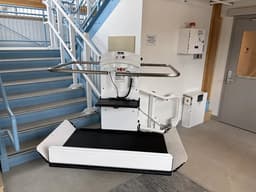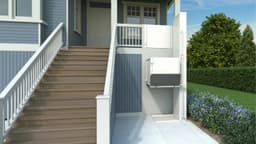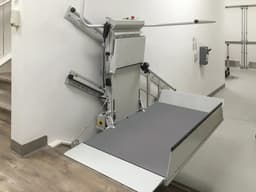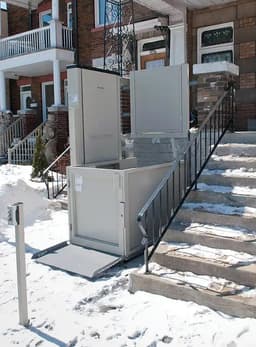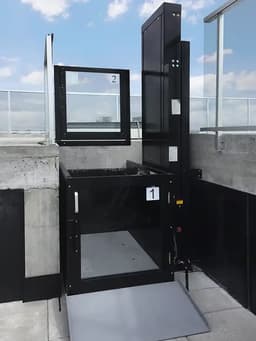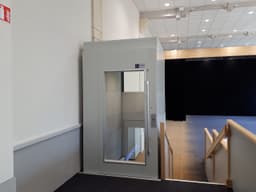
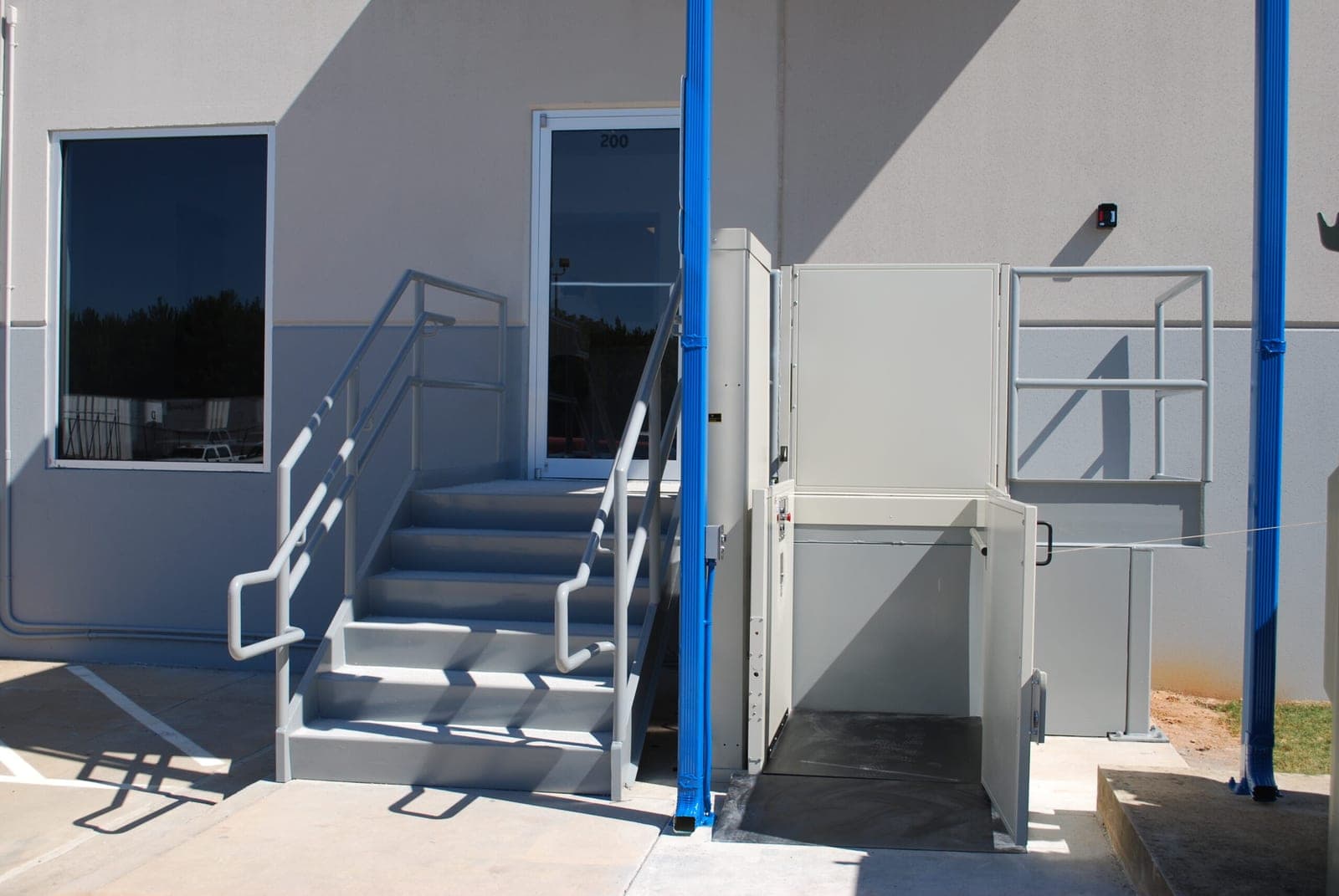
VPL-UL, VPL-EL, VPL-ELP, VPL-SL, VPL-RL at a glance
A vertical platform lift family with unenclosed, enclosed and shaftway configurations.
- Rated capacity
- 750 lb
- Speed
- 10 to 20 fpm
- Max travel (EL, ELP, SL)
- 168 in
- Power
- 115 VAC, 30 A
- Standard
- ASME A18.1
Key specifications. See the details below for model and installation requirements.
Before you plan
Choose the lift arrangement
Match the Symmetry model to the rise, entrances and proposed setting. Compare the models.
Coordinate the slab and support
Check pit, slab, wall support and headroom for the selected configuration. See site requirements.
Plan power and emergency features
Review the supply, lighting and emergency provisions with the project team. See electrical requirements.
What is a Symmetry VPL, and where does it fit?
A Symmetry VPL is a US-made vertical platform lift under ASME A18.1, used for accessible entrances, level changes and short-shaft access indoors or outdoors.
A Symmetry VPL is a vertical platform lift made in the U.S.A. by Cibes Symmetry. A machine tower beside the platform raises it between landings. The controls are hold-to-run (constant pressure): the rider holds the button on the platform, or at a landing station, for the whole trip. The lift is self-contained and needs no machine room. Speed is 10 to 20 fpm, depending on the drive.
Cibes Symmetry states that the lifts are "designed and manufactured to comply with ASME A18.1, ICC A117.1, and NFPA 70." ASME A18.1 is the safety standard for platform lifts and stairway chairlifts. It is a different standard from ASME A17.1, which covers elevators.
Where it fits. The model sheets cover commercial and residential use, indoors or outdoors. For the unenclosed lift, Cibes Symmetry lists accessible office entrances, stadium seating and low-rise changes in level in commercial buildings, and porches, landscape level changes and decks at homes. The VPL-SL is for a shaft that a contractor builds or that already exists.
Where it does not fit.
- Travel over 168 in. The hydraulic drive can reach 240 in, but only with a variance (section 07).
- Unenclosed commercial lifts over 60 in of travel.
- A new-construction accessible route, except in the locations that 2010 ADA Standards section 206.7 lists and, in New Jersey, that IBC/2024 Section 1110.11 as amended permits (section 07).
- Projects with more than two landings, until the manufacturer confirms the layout (see "Stops" in section 03).
What it is confused with. Cibes Symmetry also sells the Cibes Primo (including its outdoor concept, which Cibes also calls the Cibes Outdoor Lift) and the Cibes Air platform lifts. They are different products with different documents; see the Cibes Primo and Cibes Air guide. The Symmetry Hybrid is also a different product: a platform lift with a full-height elevator-style car in a contractor-built hoistway, covered by its own Hybrid Lift Design Guide (309.06/26) and not by this guide.
Cibes Symmetry's dealer locator lists Mobility123 as a representative for vertical platform lifts in northern New Jersey. Mobility123 sells, installs and services Symmetry VPLs in New Jersey and eastern Pennsylvania. Other vertical platform lifts have their own guides: the Savaria V-1504, the Savaria Multilift and the Bruno VPL. All platform lifts are on the wheelchair lift category page.
Which Symmetry VPL model fits the project?
Choose the VPL-UL, EL, ELP, SL or RL based on travel needed, whether an enclosure or contractor-built shaft is wanted, and residential or commercial use.
| Model | Enclosure | Max travel (in) | Enter/exit configurations | Current document |
|---|---|---|---|---|
| VPL-UL (Unenclosed) | None. Open platform with gates | 60 | Straight-through, 90 degree, 3 openings | Sheet 305.05.22 (2026); Design Guide 302.05/26 |
| VPL-EL (Enclosure) | Factory enclosure with metal infill panels | 168; 240 on hydraulic with variance | Straight-through, same side, 90 degree, 3 openings | Sheet 303.05/26; Design Guide 302.05/26 |
| VPL-ELP (Plexiglass Enclosure) | Factory enclosure with acrylic or laminated safety glass infill | 168; 240 on hydraulic with variance | Same as VPL-EL | Sheet 303.05/26; Design Guide 302.05/26 |
| VPL-SL (Shaftway) | Shaft built by the contractor | 168; 240 on hydraulic with variance | Straight-through, same side, 90 degree, 3 openings | Sheet 304.09/23; Design Guide 302.05/26 |
| VPL-RL (Residential) | None. Open platform for homes | 168 | Straight-through, 90 degree, 3 openings | Sheet 306.07/24 only |
Every model has a rated capacity of 750 lb and the same four clear platform sizes: 36 x 48, 36 x 54, 36 x 60 and 42 x 60 in. Custom sizes are available.
-
VPL-EL and VPL-ELP. The enclosure is the shaft and ships with the lift, so no separate shaft is built. The ELP is the same lift with acrylic or laminated safety glass panels in place of metal.
-
VPL-SL. The lift runs in a hoistway the contractor builds. That hoistway must allow for the lift, the running clearances and the structural requirements. Entrance doors can come from others or with the lift, but they must be flush with the inside of the hoistway to prevent shear and pinch points. The SL has no platform gate option.
-
VPL-UL in commercial work. Cibes Symmetry limits the commercial unenclosed lift to 60 in of travel. The Unenclosed technical-data web table still lists 168 in maximum travel, but the 2026 VPL-UL sheet and the design guide limit the VPL-UL to 60 in. The 168 in residential unenclosed lift is the VPL-RL.
-
The commercial VPL-UL requires a platform gate on the lower landing side, an upper landing door or gate, and a safety pan under the platform. Cibes Symmetry notes that it is "not available in every jurisdiction." Its Shaftway product page adds, for commercial applications, "where the travel is greater than 60 inches, the lift must be enclosed." The AHJ decides whether an unenclosed commercial lift is allowed.
-
VPL-RL. This is the residential unenclosed lift, shown on the Cibes Symmetry "Wheelchair home lift" page. Design Guide 302.05/26 does not cover it, and its only sheet (306.07/24, July 2024) is not linked from the current product or downloads pages. According to that sheet:
-
It uses the Acme or Accelerated Acme screw drive only.
-
A flip-up ramp is standard. The sheet lists the alarm and the grab rail as options, while the current product page lists the alarm, the illuminated emergency stop switch and the grab rail among the safety features. Confirm with the manufacturer.
-
Its gate and door options are a 36 in platform gate, a 36 in or 80 in landing gate, a non-fire-rated red oak door and a 1 1/2 hour fire-rated steel door (B-label). 40 3/8 in gates are used when travel, not counting the pit, is over 72 in, and are optional below that.
-
Its footprints are the same as the VPL-UL flip-up ramp layouts in section 03.
The product page says the VPL-RL "is ETL listed and approved" but gives no listing number. Confirm current VPL-RL details with the manufacturer before you specify it.
| Drive | Speed (fpm) | Motor (HP) | Supply | Models |
|---|---|---|---|---|
| Acme Screw Drive | 10 | 1.5 | 115 VAC | All |
| Accelerated Acme Screw Drive | 20 | 1.5 | 115 VAC | All |
| Chain Hydraulic Drive | 17-20 | 3 | 115 VAC | UL, EL, ELP, SL (not listed for RL) |
The Acme screw drives have a safety lift nut. The hydraulic drive has broken chain safeties, and its upper final limit switch is optional.
What platform size, footprint and entrances does each model need?
Minimum clear platform size runs from 36 x 48 in to 42 x 60 in, set by whether the building is new or existing and the exit layout.
Design Guide 302.05/26 sets these minimum clear platforms. It bases them on ICC A117.1 and ASME A18.1 and tells planners to consult the authority having jurisdiction (AHJ).
| Building and exit layout | Minimum clear platform (in) |
|---|---|
| Existing building, same side or straight-through | 36 x 48 |
| New building, same side or straight-through | 36 x 52 |
| Existing building, adjacent (90 degree) exits | 36 x 60 |
| New building, adjacent (90 degree) exits | 42 x 60 |
No standard size is 36 x 52 in, so a new straight-through or same-side project starts at 36 x 54 in unless a custom size is ordered.
New Jersey amends ICC A117.1 Section 410.5.2.2 (Existing buildings) so that it applies in existing buildings only "where technically infeasible to provide the door arrangement prescribed by Section 410.5.2.1" (N.J.A.C. 5:23-3.14(b)10). The design guide's existing-building sizes rest on ICC A117.1, so before drawing an existing-building platform in New Jersey, such as 36 x 60 in with adjacent doors, confirm the platform size and door arrangement with the AHJ.
Footprints. The tables give the finished width x length to reserve, in inches, from the design guide (pages 16 to 19). For the VPL-EL, the model sheet calls these the "recommended minimum pit dimension." For the VPL-SL, they are the finished hoistway.
| Straight-through, clear platform (in) | VPL-UL with pit | VPL-UL with flip-up ramp | VPL-EL / ELP | VPL-SL |
|---|---|---|---|---|
| 36 x 48 | 53 3/4 x 51 1/4 | 53 3/4 x 65 1/2 | 55 1/2 x 53 1/4 | 53 1/4 x 49 1/2 |
| 36 x 54 | 53 3/4 x 57 1/4 | 53 3/4 x 71 1/2 | 55 1/2 x 59 1/4 | 53 1/4 x 55 1/2 |
| 36 x 60 | 53 3/4 x 63 1/4 | 53 3/4 x 77 1/2 | 55 1/2 x 65 1/4 | 53 1/4 x 61 1/2 |
| 42 x 60 | 59 3/4 x 63 1/4 | 59 3/4 x 77 1/2 | 61 1/2 x 65 1/4 | 59 1/4 x 61 1/2 |
| Same side or 90 degree, clear platform (in) | VPL-UL with pit | VPL-UL with flip-up ramp | VPL-EL / ELP | VPL-SL |
|---|---|---|---|---|
| Same side 36 x 48 | Not available | Not available | 55 1/2 x 56 3/8 | 53 1/4 x 52 1/2 |
| Same side 36 x 54 | Not available | Not available | 55 1/2 x 62 3/8 | 53 1/4 x 58 1/2 |
| Same side 36 x 60 | Not available | Not available | 55 1/2 x 68 3/8 | 53 1/4 x 64 1/2 |
| Same side 42 x 60 | Not available | Not available | 61 1/2 x 68 3/8 | 59 1/4 x 64 1/2 |
| 90 degree 42 x 60 | 57 x 66 1/4 | 57 x 80 1/2 | 58 5/8 x 68 3/8 | 57 x 64 1/2 |
- Every plan shows a 39 in main tower and base, with blocking by others.
- On the VPL-UL, add 1/2 in to the finished width if the platform gate is hinged opposite the main tower and a mid-mount gate operator is used.
- The VPL-UL sheet notes that a stationary ramp adds 25 in to the finished length, and a flip-up ramp adds 14 1/4 in.
- Equipment dimensions and gate centerlines are in the design guide, pages 16 to 19. Landing gate sizes are on pages 11 and 12 (table below).
Stops. The design guide does not state a stop limit, and its wiring detail shows two landings. The web technical tables list four stops maximum. Cibes Symmetry's platform lift overview page describes unenclosed lifts as having two stops maximum. Confirm any layout with more than two landings with the manufacturer.
Doors and gates. The design guide's rules (pages 3 and 8 to 14):
- Clear opening: 32 in minimum at an end door or gate. In 90 degree applications, 36 in minimum on the narrow side and 42 in minimum on the wide side.
- Latch side: 18 in minimum clearance. ICC A117.1 may require more.
- Power operation: required in every application that is not straight-through, "depending on code year and AHJ approval." Where the 2010 ADA Standards apply, section 410.6 also requires power-operated doors or gates on a straight-through lift that serves more than two landings. The mid-mount operator has battery backup as standard in commercial applications.
- Heights: gates are 42 in tall minimum. Doors need 79 in clear inside height.
- Landings: each landing door or gate is interlocked, flush with the inside of the hoistway and anchored, because it is not free-standing. A commercial upper landing needs a gate or door at least 42 in tall. A commercial unenclosed lift needs a platform gate, which is not available on the wide side of an unenclosed platform. Keep call stations clear of door swings.
- Options: 42 in platform gate (not on the SL), 42 in or 80 in landing gates, a non-fire-rated red oak door, and a 1 1/2 hour fire-rated steel door (B label).
| Landing gate | Width A (in) | Height B (in) | Clear opening C (in) | Projection D (in) |
|---|---|---|---|---|
| Upper landing | 43 | 42 3/4 | 37 5/16 | 41 3/4 |
| Upper landing | 47 | 42 3/4 | 41 5/16 | 45 3/4 |
| Upper landing | 48 | 42 3/4 | 42 5/16 | 46 3/4 |
| Lower landing | 43 | 82 1/4 | 37 5/16 | 41 3/4 |
| Lower landing | 47 | 82 1/4 | 41 5/16 | 45 3/4 |
| Lower landing | 48 | 82 1/4 | 42 5/16 | 46 3/4 |
Add 3 in to the hinge side of a landing gate that has a mid-mount operator. The gates in this table are not self-supporting. The gate and platform share a common centerline except in 90 degree or tower-forward applications (Design Guide 302.05/26, pages 11 and 12).
| Door | Clear opening (in) | Frame rough opening W x H (in) | Notes |
|---|---|---|---|
| Red oak flush door or frame | 33 3/16 | 42 1/4 x 81 7/8 | Indoor only, non-fire-rated. Heights increase 1 7/8 in with a delay-action closer |
| 1 1/2 hour fire-rated flush door (B label) | 33 1/8 | 44 1/2 x 84 1/8 | Overall height 85 3/8 in; 1/8 in sill projection into the hoistway |
Both doors need a delay-action door closer or a power door operator "for code compliance." The door sill must sit 3/8 to 3/4 in from the platform.
How much pit, slab, wall support and headroom does it need?
Plan a 3 in pit or a ramp, a 4 in slab at 3,200 psi, and 79 to 80 in of head clearance throughout travel.
Pit
- Recommended
- 3 in
- Minimum
- 1 1/2 in, using the optional Low Profile Carriage (not on VPL-UL). It lowers the maximum lifting height by an amount the guide does not publish
- Unenclosed, no ramp
- 3 in minimum
- Outdoor pit
- Must have a means to prevent water collection
No pit: ramps
- Stationary ramp
- Projects 13 in minimum from the outside face of the lower landing door or gate, or 25 in minimum from the running clearance edge with a platform gate. Needs a door or gate operator
- Flip-up ramp
- VPL-UL option (standard on the VPL-RL); projects 15 in. Not on the side opposite the main tower or on tower-forward layouts. Needs a safety pan; commercial work also needs a platform gate and gate operator
- Ramp slope
- Not published. Confirm on the job drawings
Floor, walls and clearances
- Slab
- Smooth and level, 4 in minimum concrete, capable of withstanding a 3,200 psi compressive load. Machine base anchored to the floor
- Wall fastening
- Not required at 60 in of travel or less, except in 90 degree applications
- By others
- Blocking, and the upper gate support and barrier
- Running clearance
- 3/8 in minimum to 3/4 in maximum on entry sides; 2 in minimum on closed sides
- Head clearance
- 79 in minimum throughout travel (plan 80 in; see below)
Headroom: plan 80 in. Design Guide 302.05/26 requires 79 in minimum head clearance throughout travel. Cibes Symmetry's web technical tables and its 2020 planning drawings still list 80 in. The advisory to 2010 ADA Standards section 410.1 states that a lift without 80 in of vertical clearance cannot be considered part of an accessible route in new construction.
Plan 80 in. The local AHJ enforces the New Jersey or Pennsylvania building code, not the ADA, so an AHJ's acceptance of 79 in does not settle ADA compliance on a new-construction accessible route.
Reaction forces. The design guide (page 6) gives these loads by model height. The published travel limits (60 in for UL; 168 in for EL, ELP and SL) still apply.
| Model | Tower height / anchor height L5 (in) | Inboard floor reaction F3 (lb) | Wall reaction F5 = floor shear F7 (lb) | Max enclosure weight F6, steel / plexi (lb) |
|---|---|---|---|---|
| 42 | 67 / 43.88 | 1,536 | 702 | 497 / 437 |
| 60 | 85 1/8 / 61.68 | 1,595 | 500 | 573 / 498 |
| 72 | 97 / 75.5 | 1,634 | 408 | 650 / 568 |
| 96 | 121 / 101.44 | 1,757 | 304 | 765 / 666 |
| 120 | 145 / 123.44 | 1,833 | 250 | 867 / 754 |
| 144 | 169 / 147.7 | 1,894 | 209 | 978 / 848 |
| 168 | 193 / 168.7 | 1,989 | 183 | 1,079 / 935 |
- F3 carries the payload and platform (F1 = 1,090 lb: 750 lb payload plus 340 lb maximum platform weight) plus the tower weight. The design guide takes the outboard floor reaction as zero.
- Maximum tower weight F2 by model: 446 lb (42), 505 lb (60), 544 lb (72), 667 lb (96), 743 lb (120), 804 lb (144) and 899 lb (168).
- The values are totals. Divide by the number of bolts for individual bolt loads.
- The enclosure bears on the floor through pads, two per side. The back is the exception: there the wing walls bolt to the tower.
- For enclosures, add 175 lb for a roof and 161 lb for the 6 ft 8 in or taller option.
- The values cover gravity and operating loads only. Wind, snow, rain and seismic loads are excluded. The structural engineer applies the local building code and safety factors.
Planning help
Checking a site for this model?
Send the plans and the site measurements through the contact form.
What power, lighting and emergency features does it need?
Provide a 115 VAC feed that delivers 30 A through a 30 A fusible 2-pole disconnect, plus hoistway and auxiliary lighting.
| Item | Requirement (Design Guide 302.05/26, pages 3 and 15) |
|---|---|
| Supply | 115 VAC. Specify the supply voltage to the manufacturer |
| Feed from the main distribution center | "10-3 or sufficient to deliver 115 VAC and 30 amps to machine tower" |
| Disconnect | 30 A fusible 2-pole safety switch, provided by others. It must be a listed device conforming to NFPA 70/NEC 620.51, within sight of the motor controller, externally operable, lockable in the open position, and labeled with the location of the supply-side overcurrent protection |
| Door operators | A separate 115 VAC supply at the landing, or an additional 14-3 from the main tower |
| Landing controls | Rough in between 15 and 48 in above finished floor |
| Mechanical locks | Rough in at 25 1/2 in above finished floor on the strike side |
| Control wiring | 24 VDC. A wire chase is available on either side of the machine tower |
| Phone | Phone line run to the main tower. The ADA phone is listed as an option |
| Hoistway lighting | 5 ftc on the platform surface throughout travel |
| Auxiliary lighting | At least two lamps giving 0.2 ftc on the floor and controls for at least 4 hours. It must switch on automatically when power fails |
Size to the design guide. Design Guide 302.05/26 (May 2026) states a 115 VAC supply and a 30 A disconnect (pages 4 and 15), although its page 15 wiring legend still shows "115 or 230 VAC" line voltage. The web technical tables still list "115 VAC/25A/1 PH, 230VAC/15A/1 PH (not available for Hydraulic)", and older sheets list a 230 VAC option. Use the design guide values and confirm the voltage and circuit on the job-specific drawings.
What the guide leaves open. The design guide does not state the branch-circuit breaker size, GFCI requirements or conductor type; "10-3" is its own notation. The electrician sets those under the electrical code the AHJ enforces (NEC 2023 in New Jersey; see the code requirements page for Pennsylvania).
The design guide states the lighting levels. Cibes Symmetry's planning drawings (for example VPL035, VPL083 and VPL117, rev 0, 12/21/20) note that hoistway lighting is provided by others, so put the 5 ftc lighting and the auxiliary lighting in the electrical or GC scope. A remote-mounted controller is an option. Its size and distance limits are not published, so request them with the job drawings.
Before the hoistway is built, coordinate the electrical box locations with the lift contractor, as the design guide directs.
Emergency operation.
- A manual lowering device is standard on every model.
- Full-speed battery backup is optional. Current documents do not state its capacity.
- Emergency platform lighting and 5 ftc LED lights (with or without battery backup) are options.
- The alarm and emergency stop switch are standard. On the VPL-RL, the 2024 sheet lists the alarm as an option, while the current product page lists it among the safety features; confirm with the manufacturer.
Can a Symmetry VPL be installed outdoors?
Yes: Cibes Symmetry rates the VPL-UL, VPL-EL, VPL-SL and VPL-RL for indoor and outdoor installation, with a pit-drainage and extreme-weather package.
Yes. Cibes Symmetry's technical tables rate the VPL-UL, VPL-EL and VPL-SL for indoor and outdoor installation, and the VPL-RL sheet is titled "for Indoor & Outdoor Applications." Plan for these points:
- Pit drainage. An outdoor pit must have a means to prevent water collection.
- Extreme weather package. The design guide lists it as an option, and so do the UL, EL and RL sheets. The 2023 VPL-SL sheet does not, so confirm it for an SL. The only published description of its contents is in the September 2024 guide specifications: a powder-coat finish, with exposed components made from 304 stainless steel, galvannealed steel, hot-dip galvanized steel and aluminum. Confirm current contents with the manufacturer.
- Roof. A roof is available on the VPL-EL and ELP only; the design guide lists single, flat or double slope. A roof adds 175 lb to the enclosure load.
- Power ventilation. This is an option for EL and ELP units with a roof. It is thermostat-controlled, starts at 90 degrees, and circulates air once per minute while the lift is active. Cibes Symmetry states that "per code" the system is required when a VPL-ELP with clear plexiglass is exposed to direct sunlight. It cites no code section, so confirm with the AHJ.
- Not published. No operating temperature range, humidity limit or ingress rating is published. No document offers a coastal or marine package. For a shore site, ask the manufacturer whether the Extreme weather package suits the exposure.
Finishes. Design Guide 302.05/26 lists gray, white and black as standard colors on the VPL-UL, EL, ELP and SL, with custom colors available. The 2026 UL and EL sheets also offer ivory, brushed stainless steel and the full RAL range. The 2024 VPL-RL sheet lists ivory and grey as standard, with black, white and RAL colors available. Gates can take clear or bronze acrylic inserts.
Which codes apply to a Symmetry VPL in New Jersey and Pennsylvania?
A Symmetry VPL needs a New Jersey construction permit; in Pennsylvania it needs a DLI permit unless it serves only one dwelling unit in a solely residential building.
What Cibes Symmetry states.
-
Standards: the UL, EL and SL sheets name no edition of the standards quoted in section 01, and only the VPL-RL claims a product listing (section 02). Confirm with Cibes Symmetry that the model meets the A18.1 edition the AHJ enforces (below).
-
Planning only: the design guide "applies exclusively to national code and should not be used for construction."
-
Travel: a lift above 168 in needs the hydraulic drive and a variance, up to 240 in, and "some state and local jurisdictions have additional travel height restrictions." The variance is requested in writing in New Jersey (N.J.A.C. 5:23-2.10) and from the Elevator Safety Board in Pennsylvania (34 Pa. Code 405.3(g)).
-
Fire rating: the VPL-SL can go in a fire-rated shaft. Cibes Symmetry says the shaft should be fire-rated when it penetrates a floor or runs from a garage to a living space; the design professional proposes the rating for AHJ approval.
-
New Jersey. A VPL is an "elevator device" and needs a construction permit (N.J.A.C. 5:23-12.1(e); 5:23-2.14). The 2024 codes (IBC/2024 and IRC/2024 NJ editions, NEC 2023) took effect August 17, 2026, with a six-month grace period for applications under the prior code (5:23-1.6(a)); the elevator subcode uses the ASME editions in IBC/2024 Chapter 35, which lists A18.1-2023.
-
Where the State has elevator subcode jurisdiction, the Department of Community Affairs (DCA) reviews the plans (check the town on DCA's list); layouts are signed and sealed by a New Jersey licensed architect or engineer. A commercial lift also needs a Platform Lift Certification letter from the municipal building subcode official. A licensed elevator mechanic, or a person under one's supervision, installs the lift (N.J.S.A. 45:14H-5a, and the licensing board's rules, N.J.A.C. 13:44M-2.1 and 13:44M-5.2(c)).
-
A lift in a Group R-3, R-4 or R-5 building that is not accessible to the public needs no periodic inspection or registration (12.3(a)5; 12.4(b)); where DCA is the elevator subcode official, acceptance is by a sealed report from a New Jersey licensed engineer or registered architect (DCA policy SLCI-Admin 001-2020). Other wheelchair lifts are inspected and tested at least yearly (12.3(a)).
-
Pennsylvania. A VPL used only by the occupants of one dwelling unit in a solely residential building is outside the Uniform Construction Code's elevator chapter (34 Pa. Code 405.1(b)(3)); ask the municipal building code official about the related construction and wiring. Other VPLs need a Department of Labor & Industry (DLI) permit, acceptance inspection and certificate of operation (405.3, 405.5, 405.6), under A18.1-1999 with addenda for applications before December 20, 2026 and A18.1-2017 on or after (405.2).
-
Accessibility (public buildings only). The 2010 ADA Standards allow a platform lift on a new-construction accessible route only in the locations in 206.7. Plan the 80 in headroom (section 04) and the 410.6 power-operated doors or gates (section 03).
-
New Jersey enforces IBC/2024 Chapter 11, with items 4, 6 and 10 of its Section 1110.11 lift locations deleted (N.J.A.C. 5:23-3.14(b)10), and ICC A117.1-2017 (amendment in section 03); Pennsylvania still enforces the 2018 IBC accessibility provisions, which reference ICC A117.1-2009 (confirm the edition with the building code official).
Submission steps, forms and inspection routes are on NJ and PA code requirements.
Who does what on a Symmetry VPL project?
The owner, architect, general contractor, electrician, lift installer and manufacturer each carry a defined role, with the AHJ reviewing and permitting.
The order of work: choose the model and layout, get the job-specific drawings (the design guide is for planning only), obtain the permit, prepare the site, then install and inspect.
| Party | Responsibilities |
|---|---|
| Owner | Defines the use (private or public), the landings and the exposure. Returns the warranty card within 30 days and keeps maintenance at intervals of no more than six months. In New Jersey, registers a lift outside Groups R-3, R-4 and R-5 with DCA (section 07) |
| Architect or engineer | Selects the model and platform size. Designs the slab, walls and blocking from the page 6 reactions plus environmental loads. Details the VPL-SL shaft and proposes its fire rating. Signs and seals the layouts where required |
| General contractor | Pit or ramp, 4 in slab at 3,200 psi, outdoor pit drainage, blocking, upper gate support and barrier, VPL-SL shaft and door rough openings, and hoistway lighting if assigned |
| Electrician | 115 VAC feed for 30 A, 30 A fusible 2-pole disconnect, door operator supplies, control and lock boxes, phone line, and the 5 ftc hoistway lighting and auxiliary lighting (by others per the planning drawings) if assigned |
| Lift installer | Job drawings and box locations. Prepares the elevator permit documents with the design team and requests the acceptance inspection where one applies. Installs the lift, gates, interlocks and operators. In New Jersey the work is done by or under a licensed elevator mechanic (section 07) |
| Manufacturer | Job-specific drawings. Confirms voltage, options, stops above two landings and current VPL-RL details |
| AHJ | New Jersey: the elevator subcode official (DCA where the State has jurisdiction) reviews the plans and any variation; the municipal construction office issues the permit and the certificate. Pennsylvania: DLI issues the permit and inspects lifts under its jurisdiction. Steps are on the code requirements page |
What mistakes should planners avoid?
Common mistakes involve undersizing the electrical circuit, misreading the slab load figure, and planning headroom or gates that fall short of code.
- Sizing the circuit from an old sheet or a web table. Design Guide 302.05/26 calls for a 115 VAC feed that delivers 30 A and a 30 A disconnect. A circuit sized to 20 A or 25 A may have to be replaced.
- Reading 3,200 as a load. It is the concrete's compressive strength in psi. The inboard floor reaction is 1,536 to 1,989 lb by model. An enclosure adds up to 1,079 lb, before the roof and height adders.
- Planning 79 in of headroom on a new accessible route. The ADA advisory to section 410.1 states that a lift without 80 in of vertical clearance cannot be considered part of an accessible route in new construction.
- Specifying the VPL-UL above 60 in of travel. The UL does not go higher. Use the EL, ELP or SL, or confirm the VPL-RL for a private home.
- Putting a flip-up ramp on an enclosure, a shaftway or the side opposite the tower. The design guide does not allow it. Plan a pit, or a stationary ramp with a door or gate operator.
- Drawing same-side or 90 degree layouts with manual gates. Power-operated doors or gates are required outside straight-through layouts (design guide, depending on code year and AHJ), and under ADA 410.6 on any lift serving more than two landings. A 90 degree layout also needs wall fastening at any travel.
- Leaving out blocking and the upper gate support. Gates and doors are not free-standing, and the design guide puts both items on others.
- Leaving out drainage in an outdoor pit. The design guide requires a means to prevent water collection; without one, water collects in the pit.
- Closing up the hoistway before fixing electrical box locations. Boxes in the wrong place mean opening finished walls.
Checklists
Separate checklists cover the architect or designer, the general contractor and the electrician for a Symmetry VPL installation.
Architect or designer
General contractor
Electrician
What warranty does Cibes Symmetry publish?
Cibes Symmetry publishes a three-year limited parts warranty on the current sheets, materials only, void without an authorized dealer's installation and maintenance.
Design Guide 302.05/26 and the 2026 VPL-UL and VPL-EL sheets list a three-year limited parts warranty. Cibes Symmetry's warranty terms page adds these conditions for the "Vertical Wheelchair Lift":
- It covers defects in material and workmanship, for the original purchaser only, from the date of shipment.
- The warranty card must be returned within 30 days of the original purchase.
- It does not apply unless a Cibes Symmetry factory authorized dealer installed the lift.
- Maintenance by a factory-trained technician through an authorized dealer is required at intervals of no more than six months.
- It covers materials only. Labor and service charges are not included.
- It excludes shipping damage, misuse, neglect, improper installation or maintenance, fire, floods, acts of God and ordinary wear and tear.
The 2024 VPL-RL sheet and the 2023 VPL-SL sheet list four years. The design guide, which covers the SL and is newer, lists three. Confirm the term for a VPL-RL order.
Symmetry VPL planning questions
Does a Symmetry VPL need a pit?
It needs a pit or a ramp. A 3 in pit is recommended; a 1 1/2 in pit needs the optional Low Profile Carriage, which the VPL-UL cannot use. Without a pit, use a stationary ramp with a door or gate operator, or a flip-up ramp on the unenclosed VPL-UL or VPL-RL.
How much headroom does it need?
The design guide requires 79 in of head clearance throughout travel. Plan 80 in, which the manufacturer's web tables list and which the ADA advisory to section 410.1 states is needed for a lift to be part of a new-construction accessible route.
What electrical service does it need?
A 115 VAC feed that can deliver 30 A to the machine tower, through a 30 A fusible 2-pole disconnect within sight of the motor controller. Confirm the circuit on the job-specific drawings.
Can the unenclosed VPL-UL serve more than 60 in of travel?
No. The VPL-UL is limited to 60 in. The VPL-EL, VPL-ELP and VPL-SL go to 168 in, or 240 in on the hydraulic drive with a variance. The 2024 VPL-RL sheet lists 168 in for its residential unenclosed lift; confirm it with the manufacturer.
Does a VPL in a private home need a permit and inspection?
In New Jersey, a VPL is an elevator device and needs a construction permit. The license law exempts only chair lifts and stair lifts in a dwelling unit, so a licensed elevator mechanic, or a person under one's supervision, installs it.
A lift in a Group R-3, R-4 or R-5 building that is not open to the public needs no registration or periodic inspection, and where DCA is the elevator subcode official, a sealed engineer's or architect's report takes the place of DCA's acceptance inspection.
In Pennsylvania, a lift used only by the occupants of one dwelling unit in a solely residential building is outside the state elevator rules; ask the municipal code office about any local permit. Section 07 gives the citations.
Can a platform lift be the accessible route in a new building?
Under the 2010 ADA Standards, a platform lift may be part of an accessible route in an existing building, but in new construction only in the locations listed in section 206.7 (see the code requirements page). In New Jersey, IBC/2024 Section 1110.11 as amended also applies; confirm the location with the building subcode official. Plan 80 in of headroom (section 04).
What happens in a power outage?
Every model has a manual lowering device. Full-speed battery backup is optional. The required auxiliary light switches on automatically and gives 0.2 ftc on the floor and controls for at least 4 hours.
Sources and revision history
Show the sources and revision historyHide the sources and revision history
Manufacturer documents (Cibes Symmetry, public, US)
- Vertical Platform Lift (VPL) Design Guide, 302.05/26, May 2026. Covers the VPL-UL, EL, ELP and SL.
- Unenclosed Vertical Platform Lift sheet, 305.05.22, 2026.
- Enclosure Vertical Platform Lift sheet (VPL-EL and VPL-ELP), 303.05/26, 2026.
- Shaftway Vertical Platform Lift sheet, 304.09/23, 2023.
- Residential Vertical Platform Lift sheet (VPL-RL), 306.07/24, July 2024.
- Commercial Vertical Platform Lift brochure, 307.05/25, 2025.
- Web pages checked 2026-09-26: technical data for Unenclosed, Enclosure and Shaftway; product pages for Unenclosed, Enclosure, Shaftway and the Wheelchair home lift (VPL-RL); the vertical platform lifts overview; warranty terms; New Jersey dealer locator.
- Planning drawings, rev 0, 12/21/20, "for planning purposes only": VPL035 (UL-ST-TL-36x48-PIT), VPL083 (EL-ST-TL-36x60-PIT) and VPL117 (SL-ST-TL-36x48-PIT), linked from the technical-data pages. Used for the lighting responsibility (construction note 6) and the 80 in headroom note.
- Section 144216 guide specification, unenclosed lift (Word), September 2024. Used only for the Extreme weather package description. It is older than the design guide and differs from it on warranty and voltage.
Codes and regulations
- N.J.A.C. 5:23-1 (1.6 grace period), N.J.A.C. 5:23-2 (2.10 variations, 2.14 permits), N.J.A.C. 5:23-3 (3.14 building subcode amendments, 3.16 electrical subcode) and N.J.A.C. 5:23-12, Elevator Safety Subcode (12.1, 12.3, 12.4), current through 58 N.J.R. No. 16 (August 17, 2026).
- NJ DCA, Current Construction Codes, entries dated August 17, 2026.
- NJ DCA, Elevator Safety Plan Review/Permit Process, Rev. 01/29/2025; municipal listing of elevator subcode jurisdiction; sample Platform Lift Certification letter, June 2026; policy SLCI-Admin 001-2020, acceptance inspections of private residence elevator devices, revised January 10, 2025.
- P.L. 2012, c. 71 (N.J.S.A. 45:14H), elevator mechanics licensing law, sections 4 and 5.
- NJ Division of Consumer Affairs, N.J.A.C. 13:44M adoption notice, 50 N.J.R. 1287(a): the licensing board's definition of covered devices, which includes wheelchair lifts and any device within the scope of ASME A17.1 or A18.1 (13:44M-2.1), and its rule on installing ASME A17.1 Section 5.3 and A18.1 equipment on a residential property under a licensed mechanic's supervision (13:44M-5.2(c)).
- 34 Pa. Code 405.1, 405.2, 405.3, 405.5 and 405.6, current through 56 Pa.B. 4026 (July 4, 2026). The pages show the text as amended by 56 Pa.B. 3606, effective December 20, 2026.
- Pennsylvania DLI, Uniform Construction Code page (2018 accessibility requirements), checked 2026-09-26.
- 2010 ADA Standards for Accessible Design, sections 206.7, 410.1 (with advisory) and 410.6, U.S. Access Board.
- International Code Council, 2024 International Building Code, Chapter 35 Referenced Standards, ICC Digital Codes, Version Aug 2025, for the ASME A18.1-2023 entry. Mobility123, NJ and PA code requirements (M123-REF-001), for the permit, inspection and licensing details not repeated here.
Revision history
- Rev. 05, 2026-10-05. Licensing citation now also names the licensing board's rules as DCA applies them to home elevators and platform lifts (N.J.A.C. 13:44M; DCA Construction Code Communicator, Spring 2024), matching the code page.
- Rev. 04, 2026-09-30. Codes answer separates the New Jersey permit from Pennsylvania's exclusion. Pennsylvania's one-dwelling-unit exclusion now states its condition that the building is solely residential (34 Pa. Code § 405.1(b)(3)).
- Rev. 03, 2026-09-26. Rewritten from Design Guide 302.05/26, the current model sheets and the NJ, PA and ADA texts. Power corrected to 115 VAC with a 30 A disconnect. Warranty corrected to three-year limited parts. Slab corrected to 3,200 psi concrete. VPL-UL travel corrected to 60 in. Battery lowering corrected to optional. Unverified code section numbers removed. VPL-RL added. Pricing, schedules and VPL-Hybrid details removed. Landing gate sizes, tower weights, lighting responsibility and the web-table conflicts added. New Jersey plan release, variation, licensing, registration and acceptance steps and Pennsylvania jurisdiction, variance, wiring and accessibility rules added. Codes section condensed; details moved to the NJ and PA code page.
- Rev. 06, 2026-10-07. Licensing citation now names the licensing board's rules themselves (N.J.A.C. 13:44M-2.1 and 13:44M-5.2(c), adoption notice 50 N.J.R. 1287(a)). The Spring 2024 Construction Code Communicator, cited before, applies 13:44M-5.2(f)1 to maintenance work only.
- Rev. 02 and earlier, 2026-05-08. Superseded.
- Rev. 07, 2026-10-10. Reorganized the opening into key specifications and three linked planning takeaways. Detailed specifications and requirements are unchanged.
Next step
Planning a project with this model?
Send the plans, the travel height and the landing layout. Mobility123 sells, installs and services Symmetry VPLs in New Jersey and eastern Pennsylvania.