At a glance
Elite Straight (SRE-2010 indoor, SRE-2010E outdoor) key specs
- Rated capacity (both models)
- 400 lb
- Max incline (indoor specials to 50)
- 45 degrees
- Rail to wall, max (indoor / outdoor)
- 6 / 6.125 in
- Outdoor operating range
- 0 to 125 °F
- Charger outlet (both models)
- 120 V
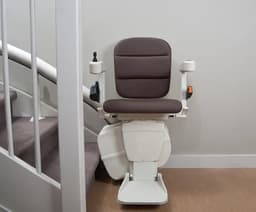
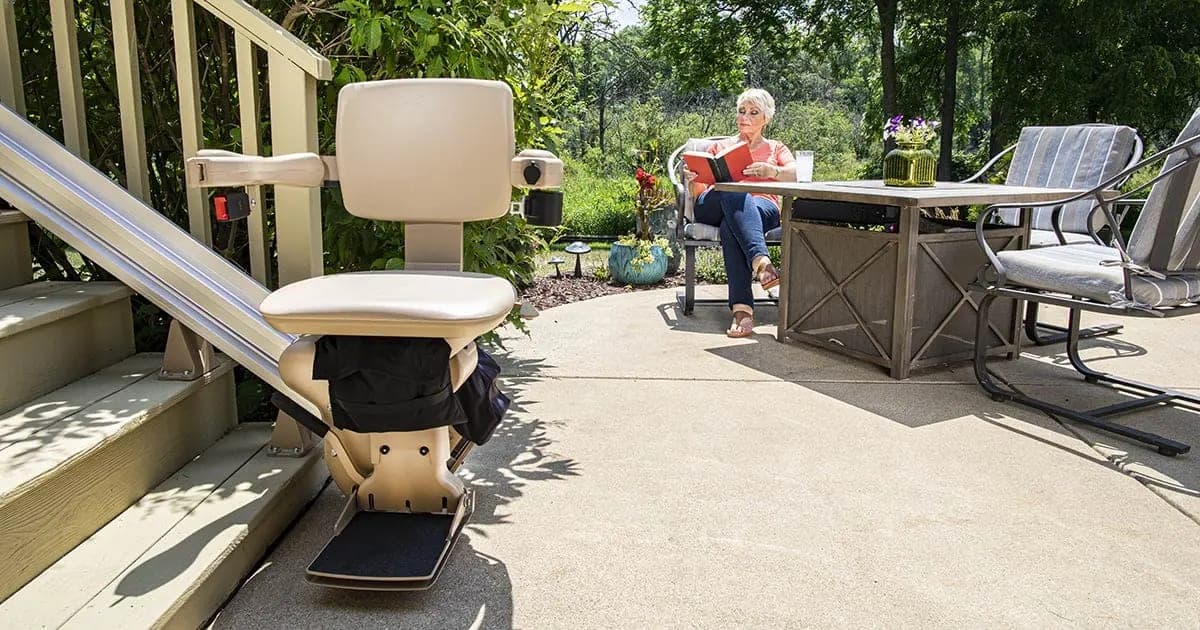
- What it is: the Bruno Elite straight, a battery-powered stairway chairlift (stairlift) for one straight staircase, built as the SRE-2010 for indoor stairs and the SRE-2010E for outdoor stairs. It carries one seated rider, not a wheelchair.
- Rated load: 400 lb (181 kg), both models.
- Stairs: up to 45 degrees; Bruno lists indoor stairs to 50 degrees as specials. Bruno does not publish a rated speed or rail lengths.
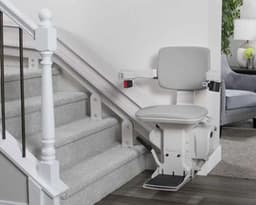
- On the stair: the rail fastens to supports on the treads. Bruno's 2025 brochures say it installs within 6 in (152 mm) of the wall indoors and 6.125 in (156 mm) outdoors. The seat, armrests and footrest fold up.
- Power: two 12 V batteries and a 24 VDC charger on a 120 V outlet that no wall switch controls. The indoor model charges anywhere on the rail; the outdoor model only when parked at either end.
- Outdoor: the SRE-2010E is designed for 0°F to 125°F (-18°C to 52°C). Bruno says its charger goes indoors, protected from the elements.
- Standard: Bruno's operator manuals say the lift is intended to be installed in accordance with ASME A18.1 (2017 edition for units with an overspeed assembly, 2014 for units without): the 2021 manual for the indoor SRE-2010 and the 2022 manual for the outdoor SRE-2010E.
- Who installs: Bruno requires an authorized Bruno dealer, or the warranty is void.
What is the Bruno Elite straight, and where does it fit?
The Elite straight is Bruno's heavy-duty stairlift for one straight staircase, rated 400 lb, built as the indoor SRE-2010 and the outdoor SRE-2010E.
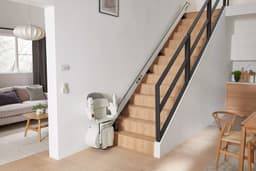
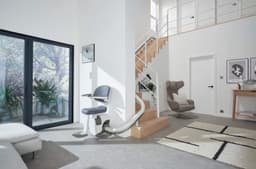
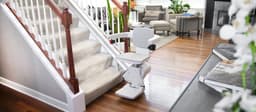
The Elite straight is Bruno's heavy-duty straight-rail stairlift: a motorized chair that travels along a rail fastened to the treads of one straight staircase. The rider sits on a folding swivel seat with a seat belt, back to the stairway wall, and holds the armrest control for the whole trip (constant pressure). Two wireless remotes call or send the empty chair.
The two models share the 400 lb rating and the seat and footrest sizes, but differ in rail position, charging, options and warranty:
- Elite Straight Indoor Stairlift, model SRE-2010. Operator manual P/N 2010-O, dated 09-15-2021.
- Elite Straight Outdoor Stairlift, model SRE-2010E. The newest operator manual found is P/N 2010E-O, dated 01-14-2022 and labeled "Residential and Commercial". This guide also cites the earlier revision of 04-02-2018 where it names it.
Where it fits. One straight staircase, indoors or outdoors, for a rider who meets Bruno's user requirements: bend the knees to travel seated, sit safely with the seat belt, push the armrest paddle, and get on and off at the top and bottom independently or with minimum assistance.
Where it does not fit.
- A stair with a landing, curve or turn. Bruno's stairlift FAQ says these need a curved stairlift; Bruno builds curved Elite models for them (Bruno Elite curved guide).
- A rider over 400 lb.
- A person who must stay in a wheelchair. The U.S. Access Board says chairlifts require transfer to a fixed seat. Plan an inclined platform lift (Savaria Delta) or a vertical platform lift (Bruno VPL).
- An accessible route where the ADA Standards apply (section 07).
Elite or Elan? Bruno's Elan SRE-5000 is indoor only and rated 300 lb. Its owner's manual says the Elan is not recommended for riders who scoot-pivot from a wheelchair with full body weight on one armrest, or whose knees buckle during the stand-to-sit transfer: "For the above type of users, the Bruno SRE-2010 Elite is recommended." Choose the Elite straight for those riders, for a rider over 300 lb and within 400 lb, or for an outdoor stair.
Bruno's dealer locator lists Mobility123 as an authorized Bruno stair lift dealer. Other models are on the stairlift category page.
How do the indoor SRE-2010 and outdoor SRE-2010E differ?
The two models share the 400 lb rating but differ in rail position, charging method, key switch, options and warranty term.
Do not carry a value from one model to the other.
| Item | Indoor SRE-2010 | Outdoor SRE-2010E | Bruno source |
|---|---|---|---|
| Rated capacity | 400 lb (181 kg) | 400 lb (181 kg) | 2025 brochures p. 6 |
| Maximum incline | 45 degrees (specials to 50 degrees) | 45 degrees | SRE-2010 manual p. 3; SRE-2010E manual p. 3 |
| Rail position | Installs within 6 in (152 mm) of the wall | Installs within 6.125 in (156 mm) of the wall | 2025 brochures p. 6 |
| Charging | Anywhere on the rail | Only when parked against the charge bracket at either end | SRE-2010 manual p. 10; SRE-2010E manual p. 7 |
| Key switch | Optional | Armrest key turned ON to ride | SRE-2010 manual p. 5; SRE-2010E manual p. 5 |
| Options Bruno lists | Seat color, power footrest, power swivel, folding rail, larger seat, larger footrest | Larger seat, larger footrest | Bruno product pages |
| Major-component warranty | Lifetime, while the original purchaser owns it | 5 years after installation (section 11) | Bruno warranties, 2025 |
Both brochures add "Not all options shown." For the outdoor model, confirm any option beyond the larger seat and footrest with the dealer before it goes on a drawing.
What are the published dimensions, and what must the survey measure?
Bruno publishes seat, footrest and swivel values for both models, but not rail length, minimum stair width or several clearances, so the survey measures them.
| Item | Value (both models unless noted) | Bruno source |
|---|---|---|
| Standard seat | 18 in wide x 15 in deep (457 mm x 381 mm) | 2025 brochures p. 6 |
| Larger seat option | 22.5 in wide x 16.5 in deep | 2025 brochures p. 6 |
| Standard footrest | 10.5 in long x 9.4 in wide | 2025 brochures p. 6 |
| Larger footrest option | 12 in long x 11 in wide (305 mm x 279 mm) | 2025 brochures p. 6 |
| Seat swivel (standard) | 0, 60 and 90 degrees at the top; 45 degrees at the bottom as an option | SRE-2010 manual p. 3; SRE-2010E manual pp. 3, 6 |
| Power swivel (indoor option) | 0 to 90 degrees, at the top of the stairway only | SRE-2010 manual p. 6 |
| Speed | Not published. Travels down slightly slower than up | SRE-2010 manual p. 4; SRE-2010E manual p. 4 |
Seat height, footrest height and the space between the armrests adjust. Bruno's stairlift guide says the armrest spacing adjusts by over three inches on both models, and the seat height by over four inches indoors and approximately four inches outdoors.
Not in Bruno's public documents. Rated speed, rail lengths, minimum incline, minimum stair width, folded width from the wall, rail height above the nosing, rail extension past the end steps, seat clearance when swiveled, seat and armrest heights, unit weight and loads on the treads. Confirm these with the dealer at the site survey. Bruno's installation manuals are not available to the public.
What the site survey measures instead.
- Stair length, total rise and angle. Indoors, over 45 degrees and up to 50 is a special order; outdoors, 45 degrees is the published maximum.
- Clear width from the rail side to the opposite handrail, guard or wall, and the walking path beside the folded chair.
- Top landing: depth, and any door, gate, wall or railing in the seat's swivel and exit path.
- Bottom landing: doorways, corners and traffic paths near the rail end.
- Treads: material, condition, nosings and finish, since the rail supports fasten to them.
- The outlet location, and whether a wall switch controls it. Outdoors, a protected indoor spot for the charger.
- The rider: weight against 400 lb, the transfer at both landings, and the seat size.
How does the rail mount, and what do the stair and landings need?
The dealer cuts the rail to length and fastens it to tread-mounted supports, on either side of the stair, with no published minimum stair width.
On the stair
- Mounting
- The dealer cuts the rail to length and fixes it to supports (Bruno calls them feet) attached to the stair treads. Bruno says about four feet secure a typical indoor straight stairlift; outdoors the number depends on rail length
- Rail
- Vertical rail with a covered gear rack. Outdoors, anodized aluminum
- Side of the stair
- Either side; the dealer recommends the side
- Stair width
- No published minimum. Measured at the survey
Bottom landing
- Transfer
- The lift runs only with the seat locked in the riding position, at a right angle to the rail. Bruno says some installations allow a 45 degree swivel to the bottom landing
- Rail end
- Next to a doorway, corner or busy hallway, it can be a tripping hazard or obstruction
- Folding rail (indoor only)
- Manual or power (see Folding rail below)
Top landing
- Exit
- The seat swivels and locks at 60 or 90 degrees so the rider exits away from the stairs
- Power swivel (indoor)
- Turns 0 to 90 degrees at the top only. Bruno does not offer it with the larger seat
Tread fastening. The rail sits on supports fastened to the treads. Bruno does not publish tread loads or support spacing, so the survey checks the tread construction and fastening surface, indoors and out.
Folding rail (indoor). Folding the manual rail with the chair below mid-travel damages the lift. The power folding rail has a motor in the hinge and a mid-travel stop, and a disable switch on its control panel allows the rail to be raised or lowered by hand in an emergency. Keep the areas above and below the folding section clear: both versions carry a pinch-point warning.
Planning help
Checking a site for this model?
Send the plans and the site measurements through the contact form.
What power and controls does the Elite straight need?
Both models charge from a 120V outlet through a 24VDC charger, but the indoor model charges anywhere on the rail while the outdoor model charges only at the rail ends.
Both models run on two 12 V batteries, and both operator manuals specify a 24 VDC battery charger powered by a 120 V outlet.
- Indoor charging: the batteries charge whenever the lift is parked anywhere on the rail. Bruno's stairlift guide says the indoor straight charger may be plugged in at the top or bottom of the staircase.
- Outdoor charging: the batteries charge only when the carriage is parked tightly against the charge bracket at either end of the rail; elsewhere they slowly discharge. The diagnostic display under the seat shows C1 while the lift charges (2022 manual, p. 7).
- Outlet: keep the charger plugged into a live outlet at all times, and do not use an outlet controlled by a wall switch (both manuals).
- Circuit: Bruno's public documents do not call for a dedicated circuit, GFCI protection, a disconnect, a receptacle height or a circuit size, and do not say how far the charger may sit from the rail. Confirm with the dealer. Bruno's manuals give the charger's maximum charging current as 2.2 A, and the 2018 outdoor manual gives its AC input fuse as 2 A slow-blow; neither is a circuit rating. The electrician sizes and protects the circuit under the National Electrical Code (NEC 2023 in New Jersey) and the authority having jurisdiction (AHJ).
- Carriage breaker: an ON/OFF switch with a built-in circuit breaker protects the battery, controller and motor circuits. A jam or a load over the rated capacity can trip it.
- Power outage: "Your stairlift is battery powered and will operate for some time during a power outage, depending on the battery condition, length of stairs and weight of rider" (SRE-2010 manual p. 4; the SRE-2010E manual says much the same). Bruno's stairlift guide gives typically 10 to 15 round trips for its indoor and its outdoor straight stairlifts. For an outage over one hour, turn off the carriage breaker and unplug the charger.
- Low batteries: the lift slows or stops. Partially charged batteries run the lift down the rail but not up.
- Manual lowering: neither operator manual describes a manual lowering procedure. Ask the dealer what the rider does if the batteries run down mid-stair.
Controls and safety. Both models use constant pressure: the rider holds the armrest control, the lift soft-starts, and it stops at the rail ends or when the control is released. It will not run unless the seat is locked in the riding position, and obstruction sensors in the footrest stop the carriage.
The two remotes call or send an empty chair only. The indoor remotes are infrared, with receivers on both sides of the carriage: keep a clear line to the carriage and keep direct sunlight off the receivers. An optional indoor key switch disables the armrest control and remotes when OFF. Bruno recommends that a non-ambulatory rider alone in the house carry a cellular or emergency communication device.
What does the outdoor SRE-2010E need for weather and charging?
The SRE-2010E is engineered for 0°F to 125°F, needs an indoor or protected charger location, and needs the cover raised and ice cleared before use.
- Temperature. Bruno's 2025 brochure says the Elite outdoor is engineered for 0°F to 125°F (-18°C to 52°C). The 2022 operator manual says the lift "has been tested to perform within the operating temperature range of 0°F (-18°C) to 125°F (52°C)" (p. 3).
- Materials. Bruno lists weather-resistant seat materials, a lightweight cover, an anodized aluminum rail with a covered gear rack, and marine-grade materials. Its stairlift guide adds exterior-grade powder-coated steel with an e-coat undercoating and weatherized electronics and controls. Bruno publishes no ingress (IP) or enclosure rating.
- Charger location. The 2022 manual says the battery charger "is designed to be mounted in a temperature-controlled, dry location" (p. 8); the 2018 manual said: "Position the battery charger indoors." Bruno's stairlift guide says the charger "plugs into a regular household outlet and should be protected from the elements." Agree the charger location and cord route with the dealer before the electrician sets the receptacle.
- Parking. If a door or gate at the top keeps the chair from parking there, the 2018 manual says to send it to the other end with a remote and call it back when needed. Plan the landings so at least one end is always available.
- Weather and storage. Riders raise the cover before use, and the owner clears ice and snow from the cover and safety mechanisms, such as the footrest, as soon as possible. For long periods of non-use, Bruno's 2022 manual has the batteries removed and the charger stored indoors (p. 9); to return the lift to service, a Bruno dealer reinstalls the batteries and greases the gear rack (Bruno stairlift guide).
What codes apply in New Jersey and Pennsylvania?
Permit and inspection requirements for stairlifts vary by state and code office, and the authority having jurisdiction confirms them.
What Bruno states. The SRE-2010 manual (09-15-2021, p. 3) says the lift "is intended to be installed in accordance with the current edition of" a list whose US entries are ASME A18.1:2017 ("Units with overspeed assembly"), ASME A18.1:2014 ("Units without overspeed assembly"), ASME A17.5/CSA B44.1-2014 and NFPA 70. It names no A18.1 section and prints an Intertek ETL Listed (C US) mark numbered 4004689. The SRE-2010E manual (01-14-2022, p. 3) gives the same A18.1 editions.
New Jersey and Pennsylvania. Permit and inspection requirements for stairlifts vary by state, building type and local code office. Confirm them with the authority having jurisdiction (AHJ) before installation. Stairlifts in commercial buildings and in the common areas of apartment buildings need a permit and yearly inspection.
Accessibility. The U.S. Access Board says stairway chairlifts cannot be used where the ADA Standards permit platform lifts. The design professional determines, and the building official confirms, whether an accessible route is required.
Who decides. The AHJ decides which code requirements apply. See NJ and PA code requirements for the rest.
Who does what on an Elite straight project?
An Elite straight project runs from the owner, architect and contractor through the electrician and dealer to the AHJ, each with a defined role.
| Party | Responsibilities |
|---|---|
| Owner | Confirms who will ride and how they transfer. Keeps the charger plugged in and the rail channel clean, and books the annual dealer examination. Outdoors, parks the chair at a rail end and clears ice and snow |
| Architect or engineer | Decides whether a stairlift meets the rider's need, and determines, with the building official's confirmation, whether an accessible route is required. Plans both landings clear of doors, gates and traffic paths. Prepares sealed layouts where the AHJ requires them |
| General contractor | Leaves the treads sound and fastenable, settles finishes before the survey and completes them before installation. Keeps the landings and the rail end clear |
| Electrician | Provides a live receptacle that no wall switch controls, where the dealer directs; for the outdoor model, indoors or protected from the elements. Sizes and protects the circuit under the NEC and the AHJ |
| Authorized Bruno dealer | Evaluates the stair and rider, recommends the side and options, cuts and installs the rail, performs the annual service and handles warranty claims |
| Manufacturer (Bruno) | Supplies the lift, the operator manual and the warranty. States the standards each model is intended to be installed under (both operator manuals list ASME A18.1). Does not make installation manuals available to the public |
| AHJ | Decides which code requirements apply |
What mistakes should planners avoid?
Common mistakes include using outdated brochure figures, switched outlets, indoor charging assumptions outdoors, and unsupported power options on the SRE-2010E.
- Using the 2019 outdoor brochure. It is still online as a PDF with older values (7 in from the wall, a 17.5 in seat pad, a 10 x 9 in footrest). A layout based on it will not match the current SRE-2010E.
- Using Elan values for the Elite. Bruno's stairlift guide gives 67 or 90 degree swivel stops for a standard indoor straight stairlift, which matches the Elan; the Elite manual gives 60 and 90. Plan the top landing from the Elite manual.
- Putting the charger on a switched outlet. The batteries stop charging when the switch is off; the lift slows, then runs down but not up.
- Planning outdoor charging like indoor charging. The SRE-2010E charges only when parked at a rail end, and Bruno says to position its charger indoors, protected from the elements. A chair left mid-rail slowly discharges, and a receptacle set outside for the charger has to be moved.
- Specifying power options outdoors. Bruno lists only the larger seat and larger footrest for the SRE-2010E, so a drawing that shows a power swivel, power footrest or folding rail on the SRE-2010E must be confirmed with Bruno or changed.
- Ordering the power swivel with the larger seat. Bruno does not offer that combination, so the seat or the swivel choice has to change before ordering.
- Counting a stairlift as an accessible route. The ADA Standards do not permit it, so where an accessible route is required the project still needs one by other means (an elevator, a LULA, or a platform lift where the ADA permits one).
Checklists
Separate checklists cover the architect or designer, the general contractor and the electrician.
Architect or designer
General contractor
Electrician
What warranty and maintenance does Bruno publish?
The indoor SRE-2010 carries a lifetime major-component warranty; the outdoor SRE-2010E carries five years, with two years on parts for both.
Indoor SRE-2010: limited lifetime warranty (Bruno warranty document, 2025-02-06). Major components (motor, gearbox, drivetrain and static rail system) for the lifetime of the stairlift as long as the original purchaser owns it; all other parts for two (2) years after installation by a Bruno Authorized Dealer; dealer labor for any defect for the first thirty (30) days after installation.
Outdoor SRE-2010E: limited warranty, 5 years on major components and 2 years on parts (Bruno warranty document, 2025-02-06). Major components (motor, gearbox, drivetrain and rail system) for five (5) years after installation by a Bruno Authorized Dealer; parts and labor as the indoor model. The one-line summary on the certificate and brochure pairs the 5-year term with lifetime wording, while the detailed terms say five years after installation. Ask Bruno to confirm in writing if the owner needs it.
Both models. Optional equipment is not a major component. Warranties start on the date of installation by a Bruno Authorized Dealer, which should be no later than 14 months after the lift shipped from the factory.
Exclusions: misuse, abuse, accidents, neglect or modifications not made by a Bruno Authorized Dealer; consumables such as remote batteries; dealer labor after 30 days; reasonable wear and tear; and, for the outdoor model, cosmetic damage that does not affect operation.
Under the indoor warranty, maintenance and repair other than the owner's own must be done by a Bruno Authorized Dealer. For the outdoor model, all service and warranty issues are handled through the Bruno Authorized Dealer that installed the unit. Both manuals say the warranty is void if anyone other than an authorized Bruno dealer installs or maintains the lift. Bruno does not cover indirect, incidental or consequential damages.
Maintenance. Keep the rail channel clean, keep the charger plugged into a live outlet, and have a Bruno dealer examine, clean and lubricate the lift at least once a year. Indoors, clean the rail surfaces, except the gear rack, with a wax-based cleaner.
Frequently asked questions
Can the outdoor SRE-2010E go on a deck or porch stair at a New Jersey house?
Bruno builds it for straight outdoor stairs up to 45 degrees, from 0°F to 125°F.
How wide does the stair need to be?
Bruno does not publish a minimum stair width or folded width; the dealer measures clear width at the site survey.
Does the Elite straight need a dedicated circuit?
Bruno's public documents do not call for one. The electrician sizes and protects the circuit under the NEC and the AHJ; confirm with the dealer.
Can the rider swivel the seat to get off at the bottom?
Only on some installations. The standard seat locks at 60 and 90 degrees at the top; Bruno lists a 45 degree position at the bottom as optional. The indoor power swivel turns 0 to 90 degrees at the top only.
What happens in a power outage?
The lift runs on its batteries for some time, depending on battery condition, stair length and rider weight; Bruno's stairlift guide says typically 10 to 15 round trips. Neither manual describes manual lowering, so ask the dealer.
Sources and revision history
Show the sources and revision historyHide the sources and revision history
Manufacturer documents (Bruno, public, US)
- Bruno Elite Straight Indoor Stair Lift digital brochure, MKT-SL-2, 2025 (file 2025-09-09).
- Bruno Elite Straight Outdoor Stair Lift digital brochure, MKT-SL-4, 2025 (file 2025-09-09).
- Bruno warranties, Elite Indoor Straight, Model SRE-2010 and Elite Outdoor Straight, Model SRE-2010E, 2025-02-06.
- Bruno, Elite Indoor Stairlift SRE-2010 Operator Manual, P/N 2010-O, 09-15-2021; Elite Outdoor Straight Stairlift SRE-2010E Operator Manual, Residential and Commercial, P/N 2010E-O, 01-14-2022, and the earlier SRE-2010E Operator's Manual, REV. 04-02-2018, cited where named; Elan SRE-5000 Owner's Manual, P/N 5000-O, 03-11-2026 (rider recommendation only). Bruno directs owners to its owner's manual search.
- Web pages checked 2026-09-26: Elite Straight Indoor Stairlift, Elite Straight Outdoor Stairlift, Stair Lift Guide, Stair Lifts Basics, dealer locator. Checked 2026-09-30: stairlift FAQ ("Staircases with landings, curves or turns require what is known as a 'curved stairlift'").
Codes and regulations
- N.J.A.C. 5:23-12 and 5:23-2, current through 58 N.J.R. No. 16 (August 17, 2026).
- NJ DCA, Current Construction Codes, checked 2026-09-26.
- 34 Pa. Code § 405.3 and § 405.7, as amended effective December 20, 2026.
- U.S. Access Board, Guide to the ADA Accessibility Standards, Chapter 4.
| Revision | Date | Change |
|---|---|---|
| Rev. 01 | 2026-09-26 | First publication. |
| Rev. 02 | 2026-09-27 | Codes section shortened. |
| Rev. 03 | 2026-09-30 | Cites the 01-14-2022 SRE-2010E operator manual, which lists ASME A18.1 and shows charging on the diagnostic display. Bruno's FAQ says a stair with a landing needs a curved stairlift. |
Bruno Elite straight
Planning a project with this model?
Send photos or a sketch of the stair, whether it is indoors or outdoors, the rider's needs and where the nearest outlet is. Mobility123 sells, installs and services the Elite straight in New Jersey and eastern Pennsylvania.