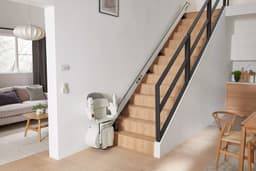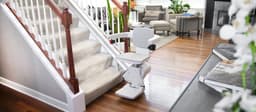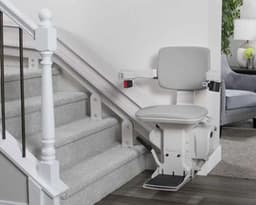
At a glance
Flow X key specs
- Rated capacity
- 275 lb
- Narrowest stair (with ASL)
- 24 in
- Max stair incline
- 72 degrees
- Speed (nominal)
- 20 ft/min
- Drive batteries
- 2 x 12 V
- What it is: the Access BDD Flow X, a battery-powered stairway chairlift (stairlift) for curved and straight indoor staircases. It carries one seated rider, not a wheelchair.
- Rated load: 275 lb (125 kg).
- Stair fit: one rail, custom-built to the staircase and mounted to the treads. Access BDD states a minimum stair width of 24 in (610 mm) with the ASL swivel-and-leveling seat (an option in the owner manual), and stair inclines up to 72 degrees.
- Travel and stops: the rail is built for each staircase and its landings. Access BDD does not publish a maximum rail length or a stop count.
- Power: two 12 V batteries (24 V total) that charge when the chair is parked at a charging point. The owner manual lists a class 2 power supply rated 100-240 VAC, 50/60 Hz, 1.7 A input.
- Standard: Access BDD's US product page lists the certification as ASME A18.1-2023, CSA B355:2024, EN 81-40:2020 and Machinery Directive 2006/42/EC.
- Indoor or outdoor: indoor only, per the owner manual.
- Who installs: an Access BDD dealer.
What is the Flow X, and where does it fit?
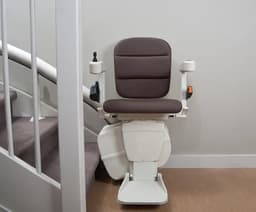
The Flow X is Access BDD's stairlift for curved and straight indoor staircases, fitting stairs as narrow as 24 in with ASL.
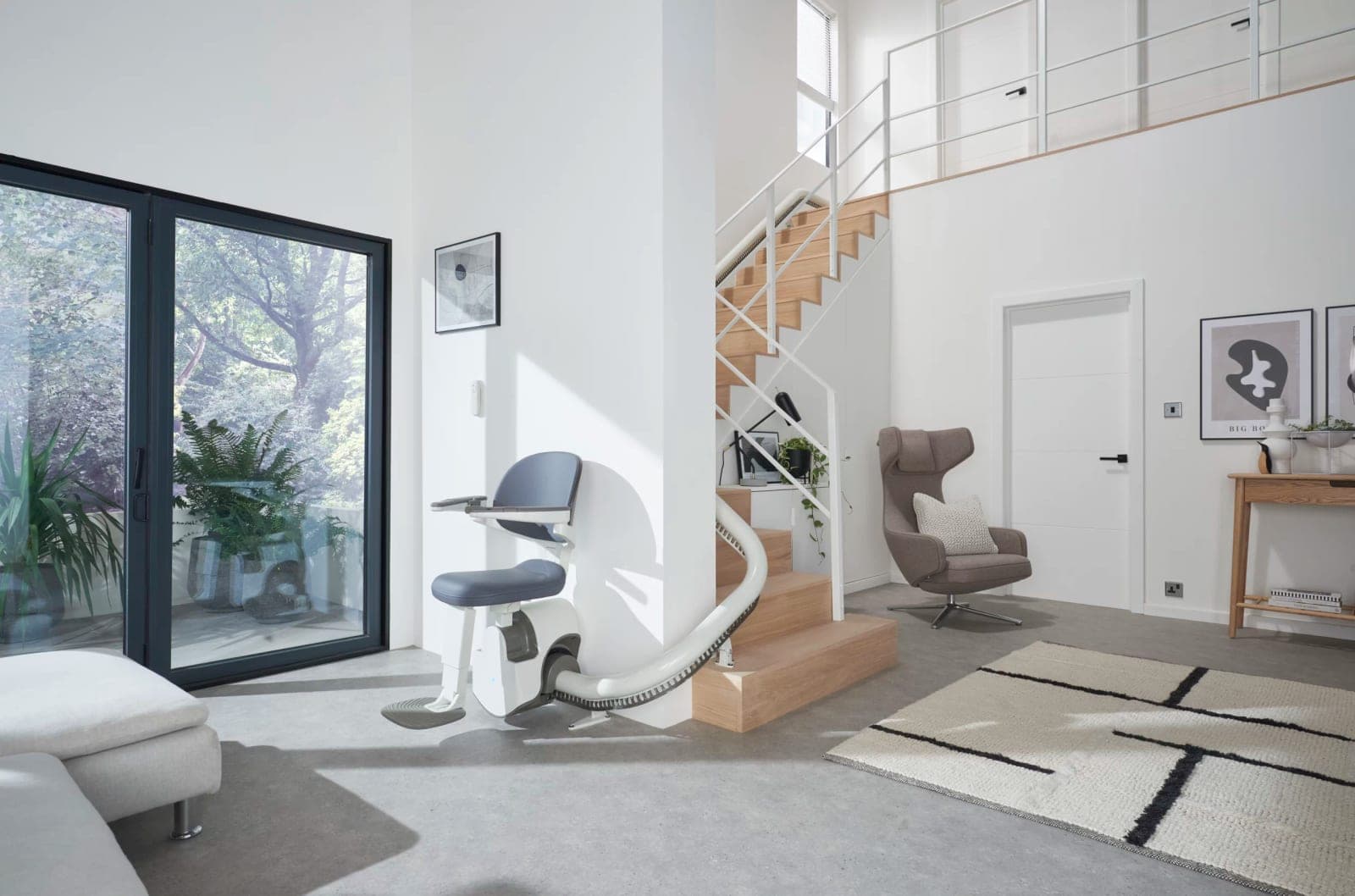
The Flow X is Access BDD's stairlift for curved staircases, and Access BDD also offers it for straight ones. A motorized chair runs on a single rail that is custom-built to the staircase and mounted to the stair treads, not the wall. The owner manual lists ASL (Advanced Swivel and Leveling) as an option.
With ASL the seat rotates and stays level while the chair moves, and the footrest swivels with the seat. Access BDD says ASL lets the Flow X fit staircases as narrow as 24 in (610 mm). The model code on the US product page is RP01-CU.
Access BDD, the reseller division of TK Access Solutions Ltd. and part of TK Elevator, is a business-to-business supplier that sells its stair lifts through approved dealers. Access BDD's US dealer locator lists Mobility123 as a stair lift dealer.
Where it fits.
- Curved stairs, stairs with turns or intermediate landings, and spiral or helical stairs.
- Narrow stairs, down to 24 in (610 mm) with ASL.
- Straight stairs narrower than Access BDD's straight model allows. Its FAQ says the HomeGlide fits straight stairs "as narrow as 29 inches" (see the HomeGlide guide).
- Stairs that others still use on foot. The rail can be installed close to the step and on either side of the staircase, and the chair folds away when not in use.
Where it does not fit.
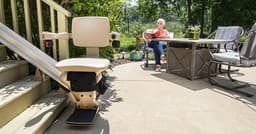
- Outdoor stairs. The owner manual says the Flow X "is intended for indoor use only." Access BDD's US site names the HomeGlide Outdoor for outdoor stairs.
- A rider over 275 lb, or two riders at once.
- A person who must stay in a wheelchair. Access BDD's FAQ says a stair lift suits users who can transfer to a seat, and an inclined platform lift suits wheelchair users who prefer to stay in their chair. Options include an inclined platform lift such as the Savaria Delta, a vertical platform lift such as the Bruno VPL, or a home elevator.
- An accessible route in a building covered by the ADA Standards (section 07).
Other curved stairlifts. See the Bruno Elite curved and Handicare Freecurve guides.
Rider checks. The owner manual sets these conditions:
- One person at a time, up to 275 lb (125 kg).
- The rider sits, wears the safety belt, keeps both feet on the footrest, and holds the joystick to travel. Releasing the joystick stops the chair.
- Minors and users with an intellectual disability ride only under supervision, and every rider carries a call device.
- The rider gets on and off only at halt points (the landings), never on the stairs.
- An optional armrest position allows a transfer from a wheelchair (section 02). The wheelchair stays at the landing.
Which Flow X options change the plan?
There is one Flow X model; the seat swivel, folding, rail ends and controls are the choices that change the layout.
There is one Flow X model. The seat swivel, folding, rail ends and control options are the choices that change the layout. Access BDD says "a variety of rail start and end options" are available; the ones not listed below, and their dimensions, are available from the manufacturer or a dealer on request.
| Item | Flow X choices | Access BDD source |
|---|---|---|
| Seat swivel | Automatic parking swivel, which turns the seat at the bottom and/or top of the stairs; or full en-route swivel with ASL, which turns and levels the seat while it moves. The owner manual lists both swivel types under optional features; specify ASL on the order wherever the layout relies on the 24 in (610 mm) width | Owner manual pp. 11-12; US product page |
| Folding | The chair folds away when not in use. Access BDD says the manual folding version is supported by a gas spring hidden in the seat; automatic seat folding is an option | Narrow staircases page; owner manual p. 13 |
| Footrest | 2 sizes, adjustable to 5 positions. Manual folding; automatic folding at the push of a button is an option | US product page; narrow staircases page; owner manual pp. 14, 24 |
| Armrests | 4 positions; position 4, for wheelchair transfer, is optional. The lift will not ride unless the armrests are in a correct, safe position | Owner manual p. 20 |
| Bottom rail end | Standard drop nose (7 in of space from the bottom step), vertical short-start drop nose (4 in), horizontal overrun, or parking curve | Narrow staircases page |
| Rail color | Colors "such as stone gray, white, pale brown, and dark brown" | Curved stair lifts page |
| Controls | Armrest detection and foldable joystick control as standard; call-and-park stations at the top and bottom; attendant control optional | US product page; owner manual pp. 2, 9, 11 |
| Seatbelt detection | Standard, per the US product page. The 2022 owner manual lists it as optional, so confirm it on the order | US product page; owner manual p. 28 |
| Call device | Optional. Calls up to three telephone numbers from the chair | Stair lifts page; US product page |
| Light Assist | Motion sensors light the seat, footrest and surrounding area; an armrest light stays on during the ride; a seatbelt light shows amber for unfastened and green for ready. A technician adjusts the brightness. The US page does not say whether it is standard | US product page; Light Assist news post |
| Other options | Key lock, 4-point safety belt, leg belt | Owner manual pp. 16-18 |
What dimensions and ratings does Access BDD publish?
Access BDD publishes rated capacity, speed, incline and seat height for the Flow X, but not rail length or tread loads.
| Item | Flow X value | Access BDD source |
|---|---|---|
| Rated capacity | 275 lb (125 kg) | US product page; owner manual p. 47 |
| Riders | One person | Owner manual p. 2 |
| Speed (nominal) | 20 ft/min (0.1 m/s) | US product page; owner manual p. 47 |
| Drive and motor | Rack and pinion; 350 W motor | US product page |
| Staircase incline | Up to 72 degrees | US product page |
| Narrowest staircase | 24 in (610 mm), with ASL | US product page |
| Seat height | 4 positions, 20 1/4 to 23 in, floor to top of seat | US product page |
| Sound pressure level | 67 dB(A) | Owner manual p. 47 |
Stops and landings. Access BDD says a trained expert evaluates the staircase layout and installs a rail tailored to its structure and number of landings. Call-and-park stations sit at the top and bottom of the stairs, and can be added at intermediate floors that have a parking point.
The chair stops at every halt point; the rider releases the joystick and pushes it again to continue. Because ASL turns the seat while the chair moves, Access BDD says it removes the need for additional stops and swivel movements on the way.
Not published. Access BDD publishes no maximum rail length, number of stops, tread loads, bracket spacing or landing space for a wheelchair transfer. The rail diameter, rail height above the nosing, rail offset from the wall, chair width and depth, folded projection, swivel clearance at the landings, and the other rail start and end options are available from the manufacturer or a dealer on request. The measurement basis for the 24 in width is not published.
What the site survey measures.
- Stair layout: every turn, landing and winder; total rise; the steepest pitch, checked against 72 degrees.
- Clear width at the narrowest point, and what bounds it: walls, handrails, balusters or newel posts.
- Bottom landing: the space from the bottom step to doors, walls and walkways, to choose the rail end.
- Top and intermediate landings: room for the seat to turn and for the rider to step off or transfer.
- Treads, nosings and finish flooring.
- Power near the charging points, lighting at each halt point, and phone service if the call device is ordered.
- The rider: weight against 275 lb, ability to transfer to a seat, and use of the joystick.
How does the rail mount, and what do the stair and landings need?
The rail mounts to the stair treads, not the wall, on either side, and is custom-built to the exact staircase.
On the stair
- Mounting
- Mounted to the stair treads, not the wall
- Side
- Either side of the staircase, installed close to the step
- Rail
- One rail, custom-built to the exact dimensions and turns of the staircase
- Folded
- The chair folds away when not in use. Folded projection: available from the manufacturer or a dealer on request
- Tread loads
- Not published
Bottom landing
- Standard drop nose
- 7 in of space from the bottom step
- Short-start drop nose
- 4 in of space from the bottom step. Access BDD suggests the drop-nose ends where the stair ends near a door or a frequently used walkway
- Horizontal overrun
- Parks the chair out of the way where there is extra space at the bottom of the stairs
- Parking curve
- Parks the chair away from the stairs
Top and intermediate landings
- Getting off
- With a swivel seat, the chair turns at the landing so the rider can get on and off more easily
- Wheelchair transfer (option)
- At the top landing, the armrest on the stair side must be locked in its riding position to form a barrier
- Call-and-park station
- Wall-mounted, at the top and bottom and, as an option, at intermediate floors with a parking point
- Lighting
- Enough light at each halt point for safe getting on and off
- Finishes first. The rail is custom-built to the staircase as the dealer measures it. Settle treads, nosings, carpet and landing floors before that survey so the rail matches the finished stair.
- Other people on the stair. The owner manual says ASL lets the lift be installed on small and narrow staircases "while making sure that other persons can still walk the stairs," and that "Remodeling work at the staircase is not necessary." The same manual says not to use the lift while anyone else is on the stairs. Plan the walking path beside the parked, folded chair, not beside a moving one.
- Gates and obstacles. The manual asks owners with an existing child stair gate to check that it still works, and to keep the stairs and rail free of obstacles. Access BDD says integrated obstruction sensors stop the lift if something is detected on the stairs.
Planning help
Checking a site for this model?
Send the plans and the site measurements through the contact form.
What power, lighting and controls does the Flow X need?
The Flow X runs on two 12 V batteries that charge when parked, plus a class 2 power supply Access BDD does not fully detail.
The Flow X runs on its batteries and charges when the chair is parked at a charging point.
- Batteries: two 12 V batteries, 24 V total (US product page). The 2022 owner manual rates them at 10 journeys at 275 lb (125 kg) over one floor height (vertical start downstairs, horizontal stop upstairs), with a 16-hour charging time (p. 47).
- Charging points: at the top and bottom of the stairs or at intermediate floors; as an option, at any additional charging point (owner manual p. 2). The manual uses "parking point" and "charging point" for the same place (p. 1). After use, the chair should always be parked at a charging point (p. 7).
- Power supply: class 2; input 100-240 VAC, 50/60 Hz, 1.7 A; output 36 VDC, 72 W (owner manual p. 47). This is Version 2.2 of the manual (2022); confirm the current rating with the dealer.
- Outlet: the manual says to keep the mains cable connected to the wall outlet and not to remove the plug from the wall socket (pp. 4, 7). Access BDD does not publish the receptacle location, a dedicated circuit, GFCI protection or circuit size. Confirm the receptacle location with the dealer. The electrician sizes and protects the circuit under the electrical code the authority having jurisdiction (AHJ) enforces: NEC 2023 in New Jersey.
- Power outage: Access BDD says the Flow X "continues to operate even during a household power outage," and that its stair lifts draw electricity only while charging their batteries.
- Main switch: the chair's on/off switch does not stop battery drain (p. 7).
- Controls: the rider holds the armrest joystick to travel and releases it to stop. An emergency stop button is in the joystick interface. The emergency lowering button, under the same armrest, is held down to lower the chair at reduced speed to the nearest halt point if it stops midway (owner manual pp. 8, 10). Call-and-park stations run on 4 AAA batteries each (p. 41). An attendant control is optional.
- Interlocks: the lift will not ride unless the armrests are in a safe position. With seatbelt detection, the joystick and attendant control do not work until the belt is fastened.
- Phone: the optional call device calls up to three numbers. The 2022 manual describes it as a Communication Module connected to a DECT telephone base station and a landline (pp. 15, 31, 33). If it is ordered, confirm with the dealer what phone service it needs.
- Public or shared spaces: where the optional key lock is used in a public space, the manual says the call-and-park stations must be stored outside the publicly accessible area or in a closable cabinet, because they can still operate the lift (pp. 16-17).
Can the Flow X go outdoors, and what environment does it need?
No. The Flow X is for indoor use only, within 23°F to 104°F and 20 to 80% relative humidity.
No. The owner manual says the Flow X "is intended for indoor use only" and to keep water and moisture away from it. Its technical data list these limits:
| Condition | Flow X range | Source |
|---|---|---|
| Ambient temperature | 23 to 104 °F (-5 to 40 °C) | Owner manual p. 47 |
| Relative humidity | 20 to 80% | Owner manual p. 47 |
Access BDD's US site gives no environmental rating for the Flow X. Check unheated stairwells, such as basement or garage stairs, against the 23 °F lower limit. For exterior stairs, Access BDD's US site names the HomeGlide Outdoor.
What codes apply in New Jersey and Pennsylvania?
Permit and inspection requirements for stairlifts vary by state and building type; confirm them with the AHJ before installation.
What Access BDD states. The US product page lists the Flow X certification as "ASME A18.1-2023; CSA B355:2024; EN 81-40:2020; Machinery Directive 2006/42/EC." It names no A18.1 part. For use outside a private residence, confirm through the dealer that Access BDD certifies the Flow X for that use, and under which part.
New Jersey and Pennsylvania. Permit and inspection requirements for stairlifts vary by state, building type and local code office. Confirm them with the authority having jurisdiction (AHJ) before installation. Stairlifts in commercial buildings and in the common areas of apartment buildings need a permit and yearly inspection.
Accessibility (public buildings only). The U.S. Access Board says stairway chairlifts cannot be used where the 2010 ADA Standards permit platform lifts (206.7), because riders must transfer to a fixed seat.
Who decides. The AHJ decides which code requirements apply, the design professional decides whether an accessible route is needed, the dealer confirms the fit to the staircase and rider, and Access BDD confirms certification outside a private residence. For everything else, see NJ and PA code requirements.
Who does what on a Flow X project?
The owner, architect, contractor, electrician, dealer and manufacturer each carry a defined task, listed in the process steps and table below.
Step 01
Check the rider and the stair
Rider weight against 275 lb, one rider, able to transfer to a seat and hold the joystick. Stair indoors, pitch up to 72 degrees, narrowest width checked against 24 in with ASL.
Step 02
Dealer survey and rail design
An Access BDD dealer evaluates the staircase layout and landings and designs the custom rail. Choose the swivel type, rail ends, folding and options.
Step 03
Prepare the stair, landings and power
Finish treads and floors, clear the landings, provide power where the dealer directs, light each halt point, and arrange phone service if the call device is ordered.
Step 04
Install, test and hand over
The dealer installs the rail and chair, and an authorized technician demonstrates how the lift operates.
| Party | Responsibilities |
|---|---|
| Owner | Confirms who will ride and how they transfer. Keeps the plug in and the chair parked at a charging point. Books yearly service with the dealer. May register the lift with Access BDD (optional) |
| Architect or engineer | Decides whether a stairlift meets the need or an accessible route is required. Plans landings clear of doors and walkways, with lighting at each halt point. Prepares sealed layouts where the AHJ requires them |
| General contractor | Finishes treads, nosings and floors before the survey. Keeps landings and the rail-end area clear. Leaves wall space for the call-and-park stations. Checks that any child stair gate still works |
| Electrician | Provides power at the charging point the dealer designates, sized and protected under the NEC and the AHJ. Provides lighting at each halt point |
| Lift installer (Access BDD dealer) | Evaluates the staircase and rider, designs and installs the custom rail, demonstrates operation, services the lift and provides the written warranty terms |
| Manufacturer (Access BDD) | Supplies the lift through approved dealers and states its certification |
| AHJ | Decides which code requirements apply |
What mistakes should planners avoid?
Most mistakes come from treating 24 in as universal, changing finishes after the survey, or leaving the rail end in a walkway.
- Treating 24 in as a universal minimum. Access BDD states it for ASL, an option in the owner manual, and publishes no measurement basis, so a layout built on it may not fit.
- Planning from old or non-US Flow X documents. They carry different model codes, certifications or speed figures, so drawings and submittals may not match the lift ordered.
- Changing finishes after the survey. The rail is custom-built to the staircase as measured, so new treads or carpet may no longer match it.
- No power at the charging point, or a plug that gets pulled. The batteries stop charging, and a chair left off a charging point runs its batteries down.
- Putting the rail end in a doorway or walkway. It obstructs traffic at the foot of the stair. Access BDD offers the 4 in short-start drop nose and a parking curve for this.
- Specifying it for an exterior stair, or an unheated stair that can drop below 23 °F. The owner manual limits the Flow X to indoor use at 23 to 104 °F and 20 to 80% relative humidity, so the lift would run outside its stated conditions of use.
- Leaving landings dark. Riders get on and off at halt points without the light the owner manual requires.
- Counting the Flow X as an ADA accessible route. The Access Board says stairway chairlifts cannot be used where the ADA permits platform lifts, so the building still lacks the accessible route the design professional found necessary.
Checklists
Confirm these architect, general contractor and electrician items before the Flow X is ordered and before construction proceeds.
Architect or designer
General contractor
Electrician
What warranty and service does Access BDD publish?
Access BDD does not publish Flow X warranty terms; ask the local dealer for the written terms before ordering.
Access BDD does not publish Flow X warranty terms on its US site. Its website terms say the lifetime warranty offer on its products "is subject to full terms and conditions," that the warranty "is provided and managed through our network of local dealers, and not directly by Access BDD," and that customers should review the terms their local dealer provides. Ask the dealer for the written warranty terms before ordering.
Registration on Access BDD's US site is optional. It produces a digital product ownership certificate, and Access BDD says "Registering your stairlift does not change the terms of your warranty."
Service. Access BDD's US FAQ says: "We recommend having it serviced at least once a year by your local Access BDD dealer." The owner manual strongly recommends annual service by an authorized service company, covering the safety functions (including the emergency lowering button and safety belt), moving parts, electronics (batteries and cabling), the drive, and the rail (fixings and grease).
Frequently asked questions
How narrow a stair can the Flow X fit?
Access BDD states 24 in (610 mm), with the ASL swivel-and-leveling seat, which the owner manual lists as an option. It does not say how that width is measured. Width requirements for a specific staircase and configuration are available from the manufacturer or a dealer on request.
Can the Flow X go on a straight stair?
Yes. Access BDD offers it for straight and curved staircases. Its straight model, the HomeGlide, is stated to fit straight stairs as narrow as 29 inches, so the Flow X with ASL is the Access BDD option for narrower straight stairs.
Does the Flow X need a dedicated circuit?
Access BDD does not publish one. The 2022 owner manual lists a class 2 power supply rated 100-240 VAC, 50/60 Hz, 1.7 A input, plugged into a wall outlet that stays connected. Confirm the receptacle location with the dealer; the electrician sizes and protects the circuit under the NEC and the AHJ.
What happens in a power outage, or if the chair stops midway?
Access BDD says the battery-powered Flow X keeps operating during a household power outage, on the charge in its batteries; the 2022 owner manual rates them at 10 full-load, one-floor journeys. If a fault stops it midway, the emergency lowering button under the joystick armrest lowers the chair at reduced speed to the nearest halt point.
Can a wheelchair user ride the Flow X?
Only by transferring to the seat. An optional armrest position helps with a transfer from a wheelchair, and the wheelchair stays at the landing. A rider who must stay in the wheelchair needs a platform lift or an elevator.
Sources and revision history
Show the sources and revision historyHide the sources and revision history
Manufacturer documents (Access BDD, public, US)
- Flow X Stair Lift product page, including the Technical Specification table and FAQs, modified 2026-07-22.
- Stair Lifts for Narrow Staircases, Curved Stair Lifts, Straight Stair Lifts and Stair Lifts, modified 2026-05-14; FAQ Hub, modified 2025-12-03.
- Emergency Lowering on the Flow X, March 10, 2026, and Light Assist, October 10, 2025.
- About Access, Find a Dealer, Product Registration and Terms and Conditions, checked 2026-09-26.
- Access Flow X stairlift User Manual, Version 2.2, part no. 1001770D (TK Home Solutions B.V., 2022). Page numbers above are the manual's printed page numbers. Access BDD does not host the manual on its US site; ask the dealer for the manual supplied with the lift.
Codes and regulations
- N.J.A.C. 5:23-2, 5:23-3 and 5:23-12, current through 58 N.J.R. No. 16 (August 17, 2026).
- NJ DCA, Current Construction Codes, checked 2026-09-26.
- 34 Pa. Code 405.3 and 405.7, text as amended effective December 20, 2026.
- U.S. Department of Justice, 2010 ADA Standards for Accessible Design, and U.S. Access Board, Guide to the ADA Accessibility Standards, Chapter 4: Elevators and Platform Lifts.
Revision history
| Revision | Date | Change |
|---|---|---|
| Rev. 01 | 2026-09-26 | First publication. |
| Rev. 02 | 2026-09-27 | Codes section shortened. |
Access BDD Flow X
Planning a project with this model?
Send photos or a sketch of the staircase, the rider's needs and where the nearest outlets are. Mobility123 sells, installs and services the Flow X in New Jersey and eastern Pennsylvania.