At a glance
Freecurve key specs
- Rated capacity
- 275 lb
- Range of incline
- 0-61 degrees
- Nominal speed (12 ft/min in curves)
- 21 ft/min
- Fold-up depth
- 16.5-17.4 in
- Power
- 24 V DC battery
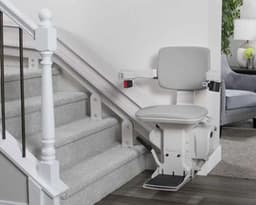
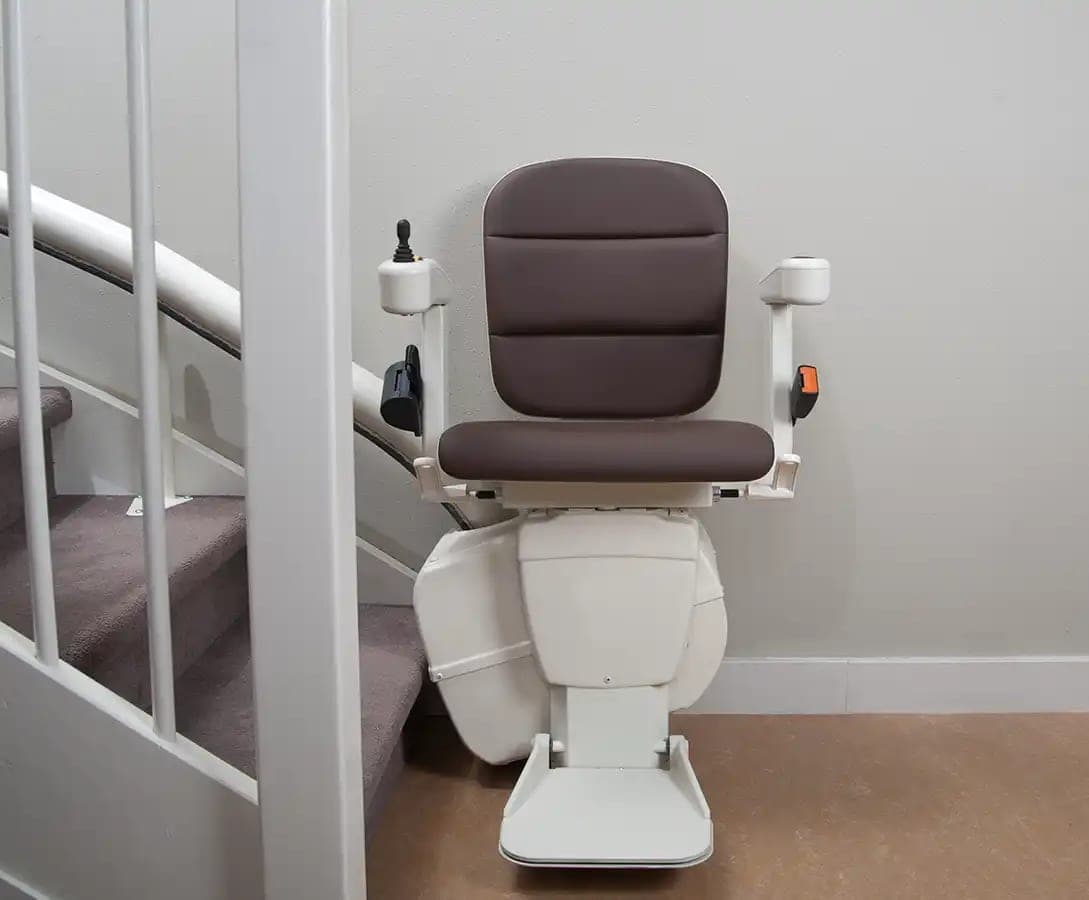
- What it is: a battery-powered curved stairway chairlift (stairlift) with a single-tube rail made for each staircase from the dealer's photo survey.
- Rated load: 275 lb (125 kg), for one seated rider.
- Stairs: turns, curves and pie-shaped treads (winders), incline 0 to 61 degrees. Nominal speed 21 ft/min (0.11 m/s), 12 ft/min (0.06 m/s) through curves.
- On the stair: the seat, footrest and arms fold up. Fold-up depth 16.5 to 17.4 in (419 to 442 mm); fold-out depth 25.1 to 26 in (638 to 660 mm).
- Power: a 0.5 hp, 24 V DC motor on batteries that charge from standard household power at the top and bottom of the rail; several trips in a power outage. The US circuit requirement is available from the manufacturer or a dealer on request.
- Standard: Handicare's 2019 declaration in the owner's manual lists ASME A18.1, with no edition.
- Indoor or outdoor: residential, indoor only.
- Who installs: dealers or installers Handicare authorizes.
What is the Handicare Freecurve, and where does it fit?
The Freecurve is a battery-powered curved stairlift with a custom single-tube rail, fabricated from a dealer photo survey of the stair.
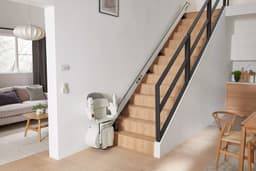
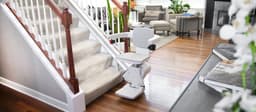
The Freecurve is a curved stairlift: a seat on a carriage that travels along a rail fixed to the staircase. Handicare calls it a "Single-Tube Curved Stairlift". The rail is one tube, custom made to follow the curves and turns of the stair. Savaria Corporation owns the Handicare brand; the Freecurve's documents are on savaria.com.
How the rail is made. The dealer measures the staircase with Savaria's PS4D photo-measuring system. Savaria's engineers create a computer-aided drawing from that survey, and the rail is fabricated in Savaria's North American factory. The PS4D system can also show the lift on the stairs in 3D before the order is placed. Savaria publishes no CAD drawing for the Freecurve.
Where it fits.
- Indoor stairs in a home that turn, curve or have pie-shaped treads (winders).
- Steep stairs. The published incline range is 0 to 61 degrees, and Savaria says the Freecurve "handles steep staircases well."
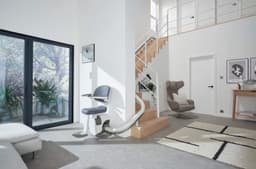
- Narrow or spiral stairs, usually with the optional two-way power swivel. It turns the seat as the lift travels, which gives the rider's knees room.
- Stairs with an intermediate landing. The owner's manual describes intermediate stops ("Tap 2 Floor"), but Handicare's US product page and brochure do not list them as standard or optional; confirm with the dealer that the ordered unit includes them.
Where it does not fit.
- Outdoor stairs (section 06).
- Public or commercial buildings. The application is residential, and the comparison chart shows no commercial option.
- A stair shared by more than one dwelling unit, until the manufacturer confirms in writing that the Freecurve meets the A18.1 requirements the AHJ enforces there. Handicare names no A18.1 section (section 07).
- A rider over 275 lb, or two people at once. The owner's manual says never to use the lift with more than one person sitting on it.
- A person who must stay in a wheelchair. A stairlift requires transfer to a seat. Plan a platform lift or a home elevator instead, such as a vertical platform lift.
- Stairs with very tight turns. Savaria says these "may be better suited to the Handicare 4000 twin-rail system." The dealer survey decides.
What it is confused with. Savaria sells two other curved stairlifts, the Handicare 4000 and the Stairfriend 23, both with double rails. The "seat measurements" link on Savaria's Freecurve web page opens a table titled "Handicare 4000/Freecurve Measurements". It lists Handicare 4000 seats (Simplicity, Style, Smart and Perch), not the Freecurve's, and its values differ from the brochure. Use the brochure values in section 03.
Which seat and options should you choose?
The Freecurve comes in three seat styles, Classic, Elegance and Alliance, with swivel, folding and rail-end options chosen before the order.
The Freecurve is one product with three seat styles: Classic, Elegance and Alliance.
| Seat | Seat colors | Active seat and body harness |
|---|---|---|
| Classic | Beige or slate | Not available |
| Elegance | Beige or brown | Available |
| Alliance | Beige with brown trim | Available |
The Elegance armrests adjust for extra width (brochure p. 2).
| Option | What it does | Applies to |
|---|---|---|
| Manual swivel (standard) | A lever lets the rider turn the seat away from the stairs at the top landing; the seat locks in position | All seats |
| One-way powered swivel | Turns the seat up to 80 degrees at the top landing, to face the landing, while the rider pushes the joystick | All seats |
| Two-way powered swivel | Turns the seat on an angle as the lift moves, so the rider travels with their back to the stairs; for narrow staircases and tight spirals | All seats |
| Powered footrest | Folds the footrest up and down from a switch on the armrest; the footrest lights when folded down | All seats |
| Power folding hinge | Folds the bottom section of rail out of the way near a door or entrance | All seats |
| Active seat | Raises the rider to a standing position and lowers them slowly to a seated position | Elegance and Alliance |
| Five-point harness (body harness) | Replaces the retractable seat belt | Elegance and Alliance |
| Parking, 90 or 180 degrees | Carries the chair around the stair railing at the top, bottom or both landings, away from the stairs | Rail |
| Overrun | Extends travel farther from the top or bottom landing, for more room to get on and off | Rail |
| Drop nose rail | A bend made into the rail at the time of order, for a less obtrusive rail at the bottom landing | Rail |
| Keyless operation | The standard unit has a key switch; it can be ordered keyless | All seats |
Parking, overrun, the folding hinge and the drop nose rail change what happens at the landings. The rail is made to order, so decide them with the architect before the order is placed.
What are the Freecurve's published dimensions and ratings?
Handicare publishes rated capacity, speed, incline range and fold depths for the Freecurve, but not rail length, stops or clear-width figures.
| Item | Freecurve value | Source |
|---|---|---|
| Application | Residential, indoor | Brochure p. 3; product page |
| Rated capacity | 275 lb (125 kg), one seated rider | Brochure p. 3; owner's manual p. 16 |
| Optional capacity | None listed | Savaria comparison chart |
| Nominal speed | 21 ft/min (0.11 m/s) | Brochure p. 3; product page |
| Speed through curves | 12 ft/min (0.06 m/s) | Product page |
| Range of incline | 0 to 61 degrees | Brochure p. 3; product page |
| Drive | Rack and pinion | Brochure p. 3; comparison chart |
| Motor | 0.5 hp, 24 V DC | Brochure p. 3; product page |
| Fold-up depth | 16.5-17.4 in (419-442 mm) | Brochure p. 3 |
| Fold-out depth | 25.1-26 in (638-660 mm) | Brochure p. 3 |
| Rail | Single tube, custom made; cream white, brown or grey | Brochure pp. 1-3 |
| Travel, rail length, number of stops | Not published | None |
Handicare does not say what the fold-up and fold-out depths are measured from (the wall, the rail or the stair). Confirm the reference point with the dealer before using them for a clear-width check.
Seat dimensions
The brochure's drawing gives six lettered dimensions for each seat without naming them; page 2 says they include the armrest width, which as drawn is C. In the side view, A runs from the rear line of the unit to the front of the backrest, and B from the backrest to the front edge of the seat.
In the front view, C is horizontal, measured at the armrests; D runs from the top of the backrest to the seat, E from the seat to the top of the footrest, and F from the top of the footrest to the floor line.
| Seat | A (in) | B (in) | C (in) |
|---|---|---|---|
| Classic | 4.1-4.9 (105-125 mm) | 14.6 (370 mm) | 17.3 (440 mm) |
| Alliance | 4.1-4.9 (105-125 mm) | 14.9 (380 mm) | 17.1-18.3 (435-465 mm) |
| Elegance | 4.3-5.1 (110-130 mm) | 14.9 (380 mm) | 17.1-18.3 (435-465 mm) |
| Seat | D (in) | E (in) | F (in) |
|---|---|---|---|
| Classic | 15.7 (400 mm) | 18.7 (475 mm) | 3.9 (100 mm) |
| Alliance | 15.5-16.3 (395-415 mm) | 19.3 (490 mm) | 3.9 (100 mm) |
| Elegance | 15.5-16.3 (395-415 mm) | 19.3 (490 mm) | 3.9 (100 mm) |
Handicare notes that "all dimensions can vary slightly due to specific site installations and adjustments." C is not the overall width of the chair: the drawing shows parts of the armrests outside it.
Not published. Handicare publishes no Freecurve value for the rail's distance from the wall, the minimum stair width, the clear width left on the stair, the swivel clearance at the top landing, the landing depth, the headroom along the rail, the overall chair width, the chair's weight, or the maximum rail length and number of stops.
The dealer's PS4D survey and the manufacturer's drawing made from it settle these for each stair. Ask the dealer for the values the design depends on.
What the survey should record for the design team.
- The stair plan, including turns, winders, landings and where the rail starts and ends.
- The clear width at the narrowest point and at each turn, with the chair folded, and the handrails and newel posts on the rail side.
- Both landings: room to swivel and step off at the top, and doors or traffic paths near the rail end at the bottom.
- Tread and stringer construction where the stanchions will stand, and the outlets near the charging stations.
What do the stair, the structure and each landing need?
A stairlift needs no pit or hoistway; the rail is carried on floor stanchions standing on the stair treads.
A stairlift needs no pit, hoistway or floor opening. The Freecurve rail is carried on floor stanchions (posts that stand on the stairs), and the chair runs along the rail.
On the stair
- Rail
- Single tube, fabricated from the PS4D survey of the stair
- Supports
- Floor stanchions. Number, spacing and fixing: available from the manufacturer or a dealer on request
- Open stair rails
- The owner's manual tells the installer to close off open stair rails, such as banisters, so the lift cannot be reached from behind
Structure
- Loads
- Handicare does not publish rail support loads
- Where in doubt
- The design professional or builder confirms the stair before the survey
Structure. The owner's manual states: "The strength and the suitability in general of wall, staircases, terraces, upper floors, banisters, plinths etc. which are to support or surround the installation have been verified and ensured by the customer, who therefore accepts all relative responsibilities."
Before the survey, repair loose treads or damaged nosings, settle the treads, carpet, nosings and railings, and tell the dealer what the treads and stringers are made of. The rail is fabricated to the measured stair, so complete the finishes before installation.
Lighting and the track. The owner's manual asks for lighting of at least 50 lux at the boarding points while the stairlift is in use, a well-lit environment with the entire track visible from the stopping places, and a track free of obstacles.
Planning help
Checking a site for this model?
Send the plans and the site measurements through the contact form.
What power and controls does the Freecurve need?
The Freecurve runs on 24 V DC batteries that charge from household power at the top and bottom of the rail.
The Freecurve runs on batteries. The brochure lists the motor as "0.5 hp, 24V (DC) power that charges on standard household power."
- Charging stations. The rail has charge points at the top and bottom, and there may be more. The lift must be parked at one to charge, and it does not work when the batteries are flat.
- Receptacle. The charger plugs into a wall socket, and the owner's manual says never to remove the lift plug from it. Plan a receptacle that stays energized, where the dealer directs.
- Circuit. Handicare's public US documents give no supply voltage, amperage, circuit, receptacle location or GFCI requirement. These are available from the manufacturer or a dealer on request. The electrician sizes and protects the circuit under the National Electrical Code (NEC 2023 in New Jersey) and the authority having jurisdiction (AHJ).
- Service lighting. The owner's manual asks for an electrical outlet at the stairlift for local lighting during inspection and servicing.
- The manual's specification table. The only Freecurve owner's manual (11P00404_K) is a multi-market edition. Its technical specification table (p. 19) lists a 230 VAC, 50/60 Hz, 1 A supply with 30 A fuses and a 0.15 m/s maximum speed. These do not match Handicare's US documents, so do not design the circuit from it.
- Power outage. The lift can make several trips on battery during a power failure. Handicare's US documents give no number of trips, battery type or charger rating.
- Emergency travel. The Freecurve has an electronically assisted emergency manual travel device that only a qualified technician may use. The owner's manual says a rider must be able to get off on their own, or call a caregiver or emergency personnel, if the lift fails. It recommends keeping a communication device at hand. Handicare does not publish the emergency lowering procedure. Ask the dealer how a rider is recovered if the lift stops between landings.
| Control or safety feature | What it does |
|---|---|
| Armrest joystick | Moves the lift up or down |
| Stop button | Stops the lift at once |
| Key switch | Enables the lift. Keyless operation is an option |
| Retractable seat belt | Standard. The five-point harness replaces it on Elegance and Alliance |
| Two remote controls | Call the lift up or down the stairs, and park it at a charge point |
| Tap 2 Floor | Owner's manual: taps on the joystick before starting select an intermediate floor, where the lift stops automatically. With a powered swivel, the seat can swivel there. Not listed on the US product page or brochure; confirm with the dealer (section 01) |
| Obstruction sensors | On the footrest and the carriage. They stop the lift if it meets an obstruction |
| Overspeed governor | Keeps the lift from traveling too fast when descending |
| End of rail | The lift stops automatically at the end of the rail |
The owner's manual says the wall buttons work by radio; Handicare's public documents show no wired call stations.
Can the Freecurve go outdoors or in an unheated space?
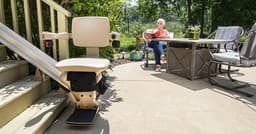
No. The Freecurve is for indoor residential use only, and Handicare warns against damp or extreme-sunlight locations.
Not outdoors. The application is "Residential, indoor". Savaria's comparison chart shows no outdoor package, and its home accessibility guide lists the Freecurve as not for outdoor use. The owner's manual says not to expose the lift to damp or extreme sunlight.
The multi-market owner's manual (11P00404_K, p. 19) lists an ambient temperature of 32 to 104 °F (0 to 40 °C), 20 to 80 % relative humidity and a use pattern of 15 rides per 24 hours (10 rides continuous). These values sit in the same table as its non-US 230 V supply values.
Confirm them with the manufacturer before placing the lift on an unheated stair or in a busy household. Savaria's warranty adds that products installed in harsh environments, such as temperature extremes, need additional maintenance to keep the warranty.
What codes apply in New Jersey and Pennsylvania?
Permit and inspection requirements for stairlifts vary by state and building type; confirm them with the AHJ before installation.
What Handicare states. The EC Declaration of Conformity in the owner's manual, dated 28 March 2019, says the stairlift "has been designed and manufactured in accordance with" a list of standards that includes "ASME A18.1, CSA B-355". It names no edition or section, and the US product page and brochure name no standard.
The declaration page also shows an Intertek ETL mark, with no listing statement or file number. The declaration predates A18.1-2023. Get in writing from the manufacturer the A18.1 edition and section the current Freecurve meets.
New Jersey and Pennsylvania. Permit and inspection requirements for stairlifts vary by state, building type and local code office. Confirm them with the authority having jurisdiction (AHJ) before installation. Stairlifts in commercial buildings and in the common areas of apartment buildings need a permit and yearly inspection.
The U.S. Access Board says stairway chairlifts cannot be used where the ADA permits platform lifts (206.7). The AHJ decides which code requirements apply; the design professional decides whether an accessible route is needed. Everything else is on NJ and PA code requirements.
Who does what on a Freecurve project?
The owner, architect, contractor, electrician, dealer and manufacturer each carry a defined task, listed in the process steps and table below.
Step 01
Check the rider and the stair
One seated rider, within 275 lb, who can transfer to a seat. An indoor stair in a home. Note turns, winders, steep or narrow sections, and both landings.
Step 02
Dealer survey
The dealer photo-measures the stair with PS4D and can show the lift on the stair in 3D. Choose the seat, the swivel, and any hinge, drop nose rail, parking or overrun.
Step 03
Review before order
The architect and owner review the rail path, the landings and any conflict with doors or traffic paths. The rail is fabricated from the survey, so changes after the order can affect the fit.
Step 04
Prepare the site
Finish the stair and landings, close off open stair rails if the installer requires it, provide the receptacles the dealer specifies, and light the boarding points.
Step 05
Install and instruct
The dealer installs the lift and instructs the users; the owner's manual limits use to adults who have signed the instructed person's declaration.
| Party | Responsibilities |
|---|---|
| Owner | Confirms who will ride. Accepts responsibility for the suitability of the supporting structure (owner's manual). Keeps the lift parked at a charge point with the plug in. Books service at least once a year and keeps the service records the warranty requires |
| Architect or engineer | Decides whether a stairlift meets the need or an accessible route is required. Reviews the rail path, landings, parking and door conflicts before the order. Specifies lighting at the boarding points. Prepares sealed layouts where the AHJ requires them |
| General contractor | Finishes treads, nosings, carpet and railings in time for the survey and installation. Confirms the stair structure where the stanchions stand. Closes off open stair rails if the installer requires it. Keeps the track clear |
| Electrician | Obtains the circuit requirement from the manufacturer or dealer. Provides an always-energized receptacle where the dealer directs, an outlet for service lighting, and lighting at the boarding points, under the NEC and the AHJ |
| Dealer and installer | Surveys with PS4D, orders the rail, installs, sets up options, instructs users, services the lift and handles warranty claims with Savaria Technical Support |
| Manufacturer (Savaria) | Draws and fabricates the rail from the survey. Publishes the brochure, owner's manual and warranty. Gives installation manuals, technical support and parts to authorized Savaria dealers only |
| AHJ | Decides which code requirements apply |
What mistakes should planners avoid?
Most mistakes come from using the wrong seat measurements, changing the stair after the survey, or missing the required annual service.
- Using Handicare 4000 seat measurements (section 01). Clearances drawn from them can be wrong.
- Designing the circuit from the owner's manual table. Its 230 V supply values do not match the US documents. Get the US requirement from the manufacturer or dealer.
- Changing the stair after the survey. The rail is fabricated to the measured stair. New treads, carpet, nosings or railings can change the fit.
- Specifying for a rider over 275 lb. Savaria lists no optional higher capacity for the Freecurve.
- Leaving the rail end in a doorway or hallway. The rail can become a tripping hazard. Plan a power folding hinge, a drop nose rail or parking.
- Putting the charger on a switched outlet or unplugging it. The batteries do not recharge, and the lift does not work when they are flat.
- Treating the stairlift as a way out in a fire. The owner's manual says it must not be used in a fire or as a means of escape.
- Missing annual service. The warranty is void without regular dealer maintenance (section 11).
Checklists
Confirm these architect, general contractor and electrician items before the Freecurve is ordered and before construction proceeds.
Architect or designer
General contractor
Electrician
What warranty and maintenance does Handicare publish?
Handicare stairlifts carry a 24-month parts warranty from shipment, with a 10-year lifetime warranty on the motor and gearbox indoors.
Savaria's "Manufacturer's Limited Product Warranty - North America" (Part No. 000599, Rev February 2025) covers Handicare stairlifts sold in North America. It states that it "supersedes all other published warranties in Owner's and Installation Manuals."
- Term: "Handicare stairlifts: 24 months warranty with additional conditions detailed herein."
- Start: the date the product ships from a Savaria or Savaria subsidiary factory or distribution center, not the installation date. Time between shipment and installation counts against the 24 months.
- Coverage: parts, repaired or replaced at the manufacturer's option, for failures due to defective material or workmanship. The manufacturer may supply factory reconditioned parts.
- Motor and gearbox: "covered by a lifetime warranty specified as 10 years for units installed indoors".
- Labor: not covered by the manufacturer's warranty.
- Transfer: original purchaser only; not transferable.
- Conditions: the product must be purchased, installed, serviced and maintained by an Authorized Savaria Dealer in conformance with all applicable local and national codes. The warranty is void if regular inspection and maintenance are not carried out by an Authorized Savaria Dealer as the owner's manual recommends. The owner keeps the service records.
- Exclusions: consumables, including batteries; wear items, including buttons, switches and upholstery; and damage from accident, misuse, improper installation, the structural condition of the building, overloading and similar causes.
- Parts bought later: "All parts purchased outside of the warranty period have a 90-day warranty."
The brochure describes "24 months parts and limited lifetime on rail and powertrain" and refers to the dealer for details. The published North American warranty defines lifetime coverage for the motor and gearbox only, as 10 years indoors. Plan on the published warranty terms.
Maintenance. The owner's manual says the stairlift "must be serviced at least once a year" by a qualified person, and needs at least two services a year if it "runs over more than 2 floors and/or has more than 2 users". Installation and servicing may be carried out only under the responsibility of dealers or installers authorized by the manufacturer.
Savaria's service page adds that while a product is under warranty, only the dealer who sold it can service it, and that Savaria gives technical support and sells parts to authorized Savaria dealers only.
Frequently asked questions
How wide does the stair need to be for a Freecurve?
Handicare does not publish a minimum stair width or the rail's distance from the wall (section 03). The fold-up depth is 16.5 to 17.4 in, with no stated reference point. For narrow or spiral stairs, Handicare offers the two-way power swivel; for very tight turns, Savaria says its twin-rail Handicare 4000 may fit better. The dealer's PS4D survey decides.
Does the Freecurve need a dedicated circuit?
Handicare's public US documents do not say. Get the circuit and receptacle requirements from the manufacturer or a dealer, and plan a receptacle that stays energized, because the charger stays plugged in (section 05).
What happens in a power outage?
The lift runs on its batteries for several trips. If the lift itself fails, only a qualified technician may move it with the emergency manual travel device; the rider must be able to get off alone or call for help (section 05).
Can a Freecurve serve an intermediate landing?
Yes. The owner's manual describes "Tap 2 Floor": taps on the joystick select the floor, and the lift stops there automatically. Handicare's US product page and brochure do not list Tap 2 Floor as standard or optional; confirm with the dealer that the ordered unit includes intermediate stops. The maximum number of stops is not published. A lift that runs over more than two floors needs at least two services a year.
Which ASME A18.1 edition does the Freecurve meet?
Handicare's declaration, dated 28 March 2019, names ASME A18.1 with no edition. New Jersey's elevator subcode references A18.1-2023. Get the edition and section in writing from the manufacturer.
Can a Freecurve serve a stair shared by two dwelling units?
Not until the manufacturer confirms in writing that it meets the A18.1 requirements the AHJ enforces there. Handicare lists the Freecurve as residential and names no A18.1 section. Confirm the code requirements with the AHJ.
Sources and revision history
Show the sources and revision historyHide the sources and revision history
Manufacturer documents (Savaria and Handicare, public, North America)
- Handicare Freecurve stairlift brochure, ©2026 Savaria Corporation, no document number (file dated July 15, 2026).
- Freecurve User Manual, Classic, Elegance and Alliance, 11P00404_K, multi-market edition, with the EC Declaration of Conformity dated 28 March 2019.
- Manufacturer's Limited Product Warranty - North America, Part No. 000599, Rev February 2025.
- Savaria web pages checked 2026-09-26: Freecurve Stairlift, Compare Stairlifts, Stairlifts, Ultimate guide to home accessibility, Power features for stairlifts, PS4D photo-measuring tool, Library Documents, CAD Drawings, Service and Repair.
Codes and regulations
- N.J.A.C. 5:23-2 and 5:23-12, current through 58 N.J.R. No. 16 (August 17, 2026).
- NJ DCA, Current Construction Codes, checked 2026-09-26.
- International Code Council, 2024 International Building Code, Chapter 35 Referenced Standards (ASME A18.1-2023), checked 2026-09-26.
- 34 Pa. Code § 405.3 and § 405.7.
- U.S. Access Board, Guide to the ADA Accessibility Standards, Chapter 4: Elevators and Platform Lifts.
| Revision | Date | Change |
|---|---|---|
| Rev. 01 | 2026-09-26 | First publication. |
| Rev. 02 | 2026-09-27 | Codes section shortened. |
Handicare Freecurve
Planning a project with this model?
Share photos of the staircase, both landings and the nearest outlets, and describe who will ride. Mobility123 sells, installs and services the Freecurve in New Jersey and eastern Pennsylvania.